United’s Distance Learning Success Story

Do you feel called to faith or justice leadership, but want to stay rooted in your community? You need a seminary that fits your needs.

At United Theological Seminary of the Twin Cities, our state-of-the-art technology allows students from around the world to study online while:
  • Becoming an involved member of the United community and classroom
  • Gaining a world-class progressive education
  • Accessing support from peers, staff, and faculty
  • Training to become an impactful leader

Why United Has an Edge

Innovation is part of United’s DNA.

Forged during the volatile social climate of the 1960s, United was never envisioned as a monolithic organization. From its inception, the seminary has demonstrated an intentionality of advancing public theology to stay current with the times, moving toward a more diverse faculty and student body—by faith traditions, gender, orientation and expression, ethnic background, life phase, and geographic location.

By extending United’s reach into a national and global sphere, we are leaning into our values of interreligious and intercultural engagement. At the same time, we are uniquely poised to equip our students to lead and minister toward justice and peace in a multi-faith world.

We offer flexibility.

In the fall of 2022, the average age of a United student was 43. Many of our students have life circumstances that make compulsory in-person attendance difficult, as they are rooted in their communities—homes where they want to stay and make an impact.

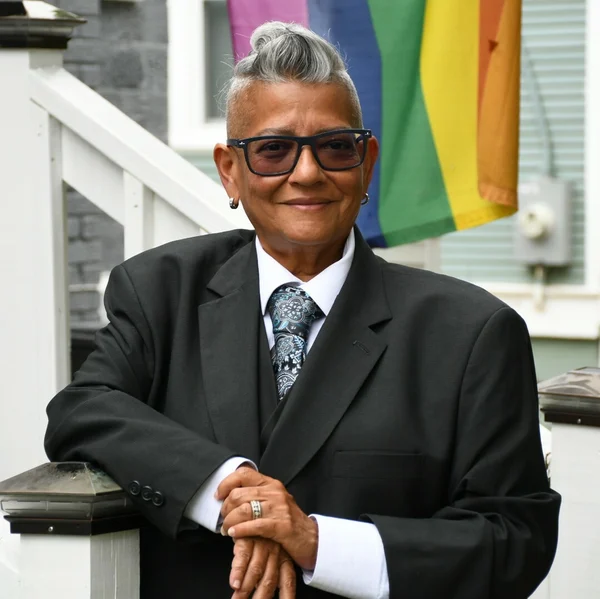
Lisbeth Melendez Rivera—a 35+ year veteran of social justice work, and recent candidate for city council in Hyattville, Maryland—worked on a Master’s degree while living on the East Coast. “I’ve conducted my entire learning experience on Zoom,” she shares, “and it has been a fantastic experience.”

Being able to learn from a distance was essential for Rivera. “I was able to work and get assistance from my union to complete my studies,” she explains. If she were required to move, Rivera adds, “that would not have been possible.”

Our leadership promotes transformation through distance learning.

Our technological investment was a calculated plan, and not a sudden pandemic-inspired shift. United, when it moved in 2019 to its Saint Paul home in the CASE building, deliberately advanced its technological capabilities in the new space.

The city-centered campus, with its modern and tech-friendly design, is near light rail and bus routes. As such, it is far more accessible for both commuters and distance learners.

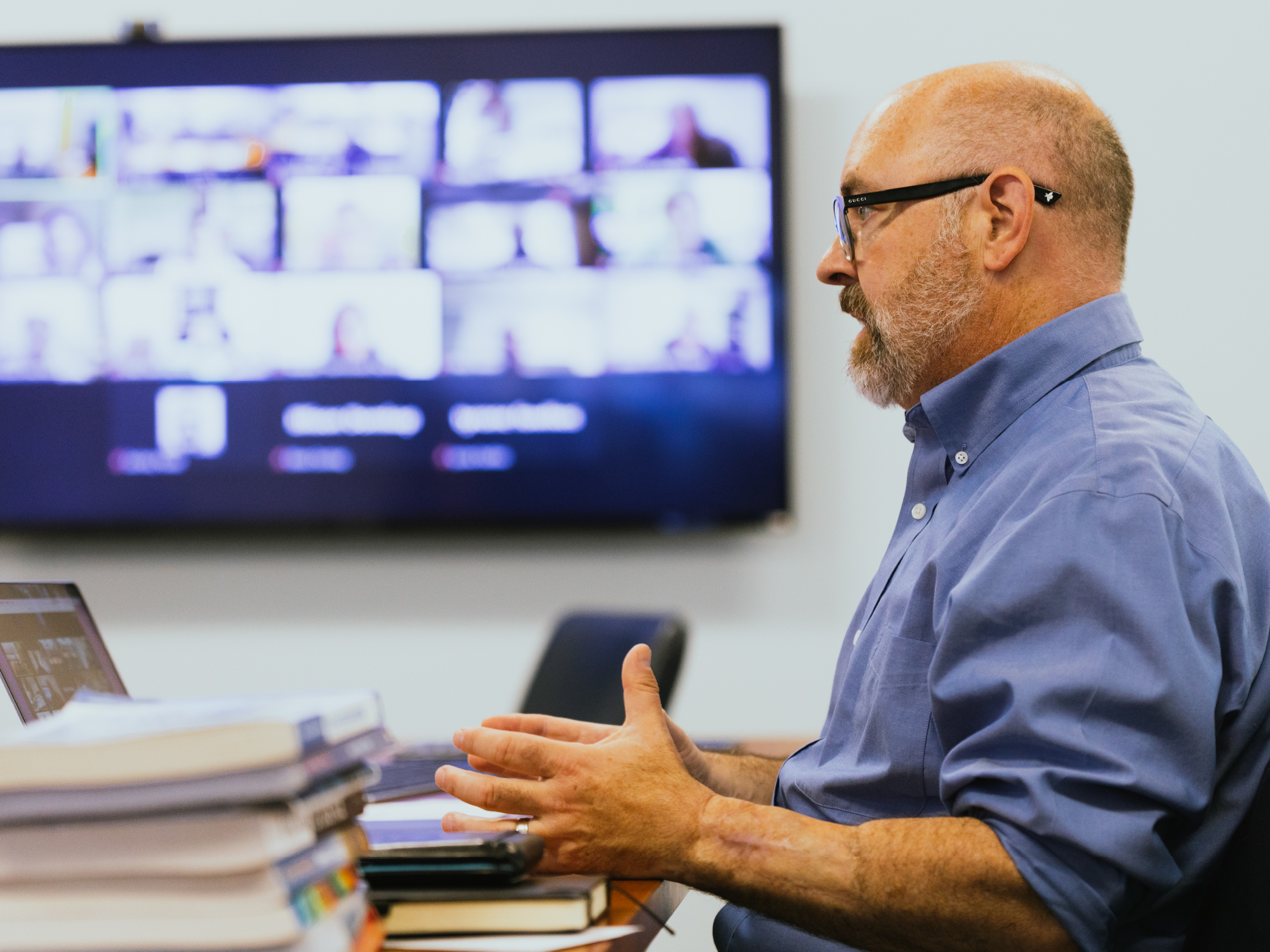
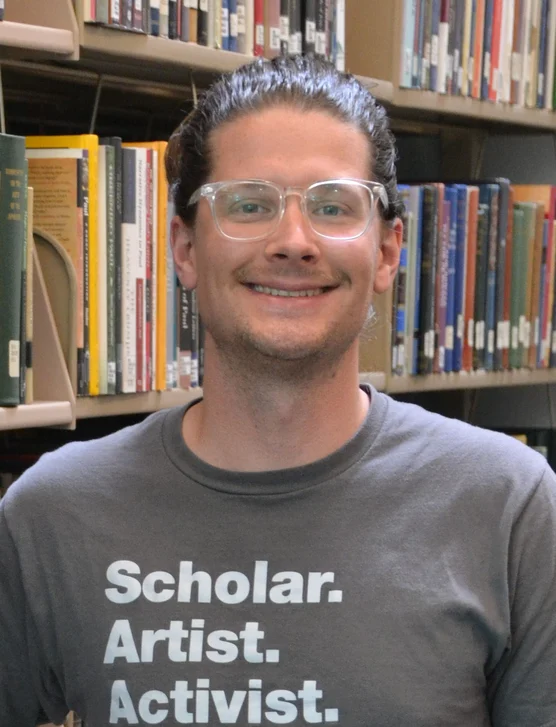
Pictured at left, Rev. Mason Mennenga—a United alum, employee, and podcast host of A People’s Theology—admits that the seminary has a “Zoom culture.” “It’s a great thing,” he adds.

“Our distance students feel like there is a distinct community built among them. This is especially rare for seminaries and there is a reason why we often have students transfer from other distance programs to ours, because we offer a leading distance program. In fact, we have been doing Zoom courses for almost five years, well before the pandemic, so we have been able to develop a community of students over Zoom far longer than other seminaries.”

The Nuts and Bolts

Synchronous classes allow for discussions in real time. Each one of our classrooms has high-quality microphones, high-definition cameras, and flatscreen TVs so that the online/in-person interaction in the classrooms is as seamless as possible.

As one recent distance learning graduate asserts, “distance learning worked for me because I always felt like I was a part of the United community.”

Asynchronous pedagogy—a modality that allows students to access content and move at their own pace—is the most flexible option for our faculty and students. It also allows students and faculty to be a little more creative.

For asynchronous classes, as Associate Professor of Theology and the Arts Dr. Jennifer Awes Freeman explains, she creates a personal introduction (sometimes on video) and invites her students to create and post their own introductions. These self-directed introductions allow students to discover commonalities as well as unique points of interest and start to form a community.

Awes Freeman adds, “In my course design and interactions with students, I strive to create an accessible, transparent, and collaborative learning environment. Regular and open communication, coupled with responsive pedagogy (such as incorporating additional resources in response to student questions), helps to foster learning online.”

Rivera (pictured at right) notes that she has been able to meaningfully connect with United’s faculty and fellow students online. She also “highly values” the opportunities she had to serve on the Student Leadership Council, take part in the Committee Advocating for Racial Justice (CARJ), and meet one-on-one with faculty.

Rivera even organized an online “pancake breakfast” with her fellow students. “I asked, as part of my project, for my classmates to help me organize a common space where each student brought their favorite pancakes, or something that met their dietary requirements, with extra servings to share.” Students find ways to make community, both when they are online and on campus.

Synchronous classes allow for discussions in real time. Each one of our classrooms has high-quality microphones, high-definition cameras, and flatscreen TVs so that the online/in person interaction in the classrooms is as seamless as possible.

United also has a selection of library resources available online, including eBooks and journal articles. Dr. Tim Sena, director of the Spencer Library, notes that he is “working on increasing the number of these resources all the time.” The pandemic also created an impetus to make the online library even more accessible.

Translating Online Learning to Ministry

United is educating leaders to serve in many impactful ways—congregational ministry, chaplaincy, nonprofits, arts organizations, public policy roles, academia, social services, and more. Our unique curriculum, which incorporates social transformation, the arts, and interreligious dialogue, helps to better inform and ground advocates for justice, equity, inclusion, and love for all.

As one alum has stated, “United understands that students are not solely called to preach and teach within the walls of an institution, but to take our witness into the public square.”

On a more practical level, all students—whether distant or on campus—have chances to take leadership roles in student affinity groups, the student leadership council, United chapel services, and other events that United hosts live and via livestream. With help from our chaplain, students also have access to personal counseling and CPE (Clinical Pastoral Education), an interfaith hands-on learning practicum.

What’s more, all that technology is increasingly part and parcel of ministries, nonprofits, and many other businesses today. Notes one 2022 graduate, “Technology is a huge part of ministry, and United prepared me to hit the ground running in my new church home.”

Those who founded United Theological Seminary were uniquely prescient in their vision for aligning the new seminary with the newly formed United Church of Christ. Steeped in the turmoil of the 1960s, the founders recognized the importance of an ecumenical seminary, foresaw “professional preparation of men and women (emphasis added),” and dedicated themselves to providing “the most adequate program of theological education possible.”¹

Sixty years later, as our nation calls for racial justice and slowly recovers from the unprecedented pain of a worldwide multi-year pandemic, United’s students, alums, and faculty have been creative, ethical, and compassionate leaders. Girded with our foundational values and modern technology, we have learned to lead worship in new ways, coordinate public forums, work to transform society, minister to hurt communities, and keep providing quality theological education in person and through distance learning.


1.  Merrill, Arthur L. United Theological Seminary of the Twin Cities: An Ecumenical Venture (New York: The Edwin Mellen Press, 1993), 287–288.]

Explore More Articles

United Celebrates Largest New Class and Highest Enrollment in Its 65-Year History

Enrollment Has More than Tripled in Ten Years For the second consecutive year, United Theological Seminary of the Twin Cities (United) is thrilled to welcome its largest-ever incoming class of degree-seeking students. With 85 new degree-seeking students, the seminary is celebrating a total fall term enrollment of 288 degree-seeking students and 7 certificate students, representing the largest total enrollment in United’s history. The seminary’s 65th academic year features: 25% year-over-year enrollment growth and a staggering 239% increase over fall 2016; 163 Master of Divinity (MDiv) students, an increase of 42% year-over-year; 63 Master of Arts (MA), Master of Arts in Leadership (MAL), and Master of Arts in Ministry (MAM) students; 62 Doctor of Ministry (DMin) students. Public theology, social transformation, interreligious engagement, and theology and the arts comprise the four foundational pillars of United’s curricula. They are unique among seminaries and divinity schools rooted in Christian traditions, cultivating an educational environment that practices ecumenism, religious pluralism, and social justice. The MDiv in Interreligious Chaplaincy is United’s largest degree program, with 73 students enrolled for the fall term. The concentration’s interfaith emphasis sets the school apart among its peers, drawing students from diverse backgrounds and faiths. Reflecting the program’s flagship status, the seminary marked a new milestone on July 1 when it welcomed Dr. Ginger Morgan as associate professor for Pastoral and Spiritual Care and program director for Interreligious Chaplaincy. United’s considerable ten-year growth can be credited to its leading-edge academic offerings, widely accessible distance education, and accomplished faculty. The seminary is a bold witness for the common good, preparing innovative leaders for myriad vocational and professional outcomes. From rural congregations to the city hospital’s ICU, United students and alums equip their communities for justice and peace. Mason Mennenga (’22), director of Admissions, leads a passionate and creative staff, all of whom are current students or alums. He reflects, “United’s growth in enrollment over the last number of years and our record for this year is truly a remarkable achievement in theological education. We’re showing what’s possible for progressive theological institutions!” Dr. Hillary Vamstad, director of Student Services, adds, “We’ve created an environment where students feel more than just a number, and I think students see that through the admissions and onboarding process. Feeling seen, heard, and supported while pursuing a seminary education is an important component to United’s growth.” Growth in student enrollment underscores the need to increase the number of core faculty members to continue to provide the quality of education for which United is well-known. Dr. Kyle Roberts, Vice President for Academic Affairs and Dean, shares, “We are undertaking two faculty searches this year, which include an additional faculty role focused on Ministry Practices. This is a specialty we have been needing for some time on our core faculty to ground students in the practical elements of ministry leadership, such as preaching and liturgy, religious education, institutional leadership and administration.” Rev. Dr. Molly T. Marshall, who is beginning her final year as United’s beloved president, asserts, “I believe United’s remarkable growth is due to our progressive and relevant curriculum, our theological hospitality, and our accessible educational delivery.” She continues, “We delight in creating space (perichoresis) for everyone who desires formative theological education, a distinctive pursuit among seminaries.” United looks ahead to a historic 65th year of progressive theological education, and we give thanks for the students whose vocations, traditions, and unique perspectives enrich the life of our seminary. About United Founded by the United Church of Christ (UCC) as a welcoming, ecumenical school that embraces all denominations and faith traditions, United Theological Seminary of the Twin Cities has been on the creative edge of progressive theological thought and leadership since it was established in 1962. Today, United continues to educate leaders who, through the eyes of faith, engage in the dismantling of systems of oppression, explore multi-faith spirituality, and push the boundaries of knowledge. Media Contact Nathanial Green (he/him) Director of Marketing and Communications press@unitedseminary.edu • 651.255.6138 Admissions and Enrollment admissions@unitedseminary.edu

United Launches National Search for Its Next President

The Position Profile and Application Are Now Available Today, the Presidential Search Committee, on behalf of United Theological Seminary of the Twin Cities, is opening the national search for the seminary’s next leader. This comes after the July announcement of Rev. Dr. Molly T. Marshall’s 2027 retirement following six transformative years of institutional growth and expansion. United’s next president will helm a dynamic school with a student body that has more than doubled in size in just ten years; a world-class faculty of artists, scholars, and theologians; and a diverse and interreligious student body preaching in pulpits, ministering in ICUs, leading nonprofits, and organizing for the common good. In a message shared with the United community, trustee and committee chair Rev. Dr. Kenneth V. Daniel (’81) describes the committee’s work in concert with executive search firm Isaacson, Miller (IM) to help “the seminary step into the next chapter of United’s mission and ministry.” Describing the ideal candidate, Dr. Daniel writes, “We are seeking an engaged leader who will join our mission to inspire creative scholarship, advance innovative pedagogy, develop leaders of distinction, and move the school forward to increased sustainability and global impact.” As of today, the public profile of the President’s role, as well as the application, is available to prospective applicants. Additionally, the public is invited to nominate individuals for consideration by the Committee. The application is linked on an official landing page that features Dr. Daniel’s note and a list of the committee members and their affiliations. The committee includes trustees as well as current and former faculty, student, staff, and alum representatives. Each faithfully brings their experiences to bear on their assignment. Dr. Daniel urges qualified leaders from myriad backgrounds to consider applying, writing, “Leaders from interfaith and ecumenical traditions, academic disciplines, relevant professional and denominational roles, and innovators in educational practices are invited to consider this unique opportunity.” Visit the link below to learn more, nominate a candidate, or submit your application. Apply or Nominate a Candidate About United Founded by the United Church of Christ (UCC) as a welcoming, ecumenical school that embraces all denominations and faith traditions, United Theological Seminary of the Twin Cities has been on the creative edge of progressive theological thought and leadership since it was established in 1962. Today, United continues to educate leaders who, through the eyes of faith, engage in the dismantling of systems of oppression, exploring multi-faith spirituality, and pushing the boundaries of knowledge. Search Committee Contact Grace Pennings Guenthner (’26) Administrative Assistant, Presidential Search Committee pssearch@unitedseminary.edu

United Welcomes Site Visit by The Association of Theological Schools’ Commission on Accrediting

United Theological Seminary of the Twin Cities is hosting a comprehensive evaluation visit for reaffirmation of accreditation by the Association of Theological Schools’ Commission on Accrediting on October 12–15, 2026. The purpose of this visit is to verify that the school meets all applicable Commission Standards of Accreditation. Comments regarding how well the school meets those standards and/or generally demonstrates educational quality may be sent to accrediting@ats.edu at least two weeks before the visit. Comments may also or instead be sent in writing to the Dean of the Seminary Kyle Roberts at kroberts@unitedseminary.edu. All comments will be shared with the onsite evaluation committee. For more about United's accreditation, click here. >