United’s Brief Foray into Football: 1967–1968

These days, it’s hard to imagine that United would ever have fielded a football team—flag or full contact. More than 50 years ago, however, it almost made sense. As Ted Meads (’71) and former seminary student Phil Johnson (pictured at right) recall, “When school started in the fall of 1967, a gaggle of seminarians played touch football on campus most afternoons.” There were also other sporting events. Phil and Ted 3 7.25.23-Lightroom
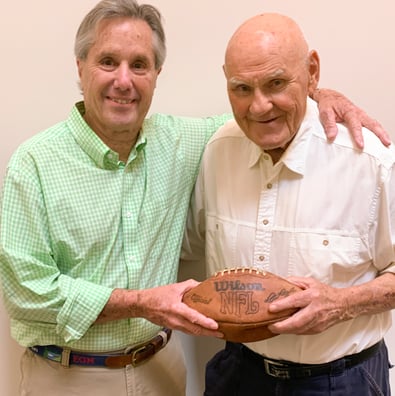
It is important to remember that seminarians and faculty in the 1960s were predominantly male. United’s first woman MDiv graduate, Marilyn Creel, didn’t cross the stage until 1972, and the first female faculty member on regular appointment, Patricia Wilson Kastner, wasn’t installed until 1975.

So, when Mike Groh* (’69) asked his seminary mates if they wanted to play full-contact football against the Stillwater Prison football team, he was able to assemble a team, albeit a small one. At the time, Mike and Gary Miller* (’68) were ministering at the prison and had learned that the Colts (the prison team) had an opening in their schedule. 

The Motivation for Playing

Fielding a football team was not a meaningless diversion for seminary students. Between seminary classes, clinical pastoral education opportunities, and internships, the men were plenty busy. Ted and Phil like to think of this exercise as part of a continuum of practical social ministry promoted by United and its faculty.

As they recollect, seminarians had driven to Milwaukee to march with activist Father James Groppi in support of a strong open housing law in the city. Others had gone door-knocking on behalf of candidates who opposed the Vietnam War. Several of their classmates interned with the Inner-City Project for Youth, formed by three Minneapolis churches in 1968, and those who took Wilson Yates’ Religion and Society course visited prisons in Lino Lakes and St. Cloud.

Logistics
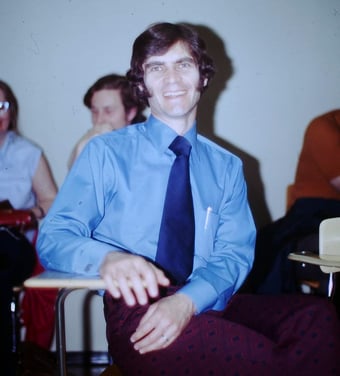
DonWhite-1Outfitting a team with protective gear was the first challenge. Happily, Gary was able to borrow used shoulder pads and helmets from the high school at which he was working in 1967. In 1968, Dave Rumpf (’70) collected used football equipment from Augsburg College where he was interning.

The title of coach went to Professor Donald White,* United’s Professor Emeritus of Constructive Theology (1965–2002), pictured at left. Dr. White enjoyed the game and liked to view it from a process theology angle.

As Don explained recently, “The key element of process theology demands a focus on the concrete, the specific at all levels, including the sub-atomic. For football, you are driven to the specific, the concrete, in all of its complexity. The second key element states that God is always seeking to lead us, as well as all things in the universe, at the same instant.

“The problem remains that we are seldom aware of God’s leading, which seeks to move us toward the best possible outcome along with all of the particular universal participants. This means that God does not favor any team or player. [Phil and Ted] have often claimed that the best part of the experience of playing the prison football team remains the sharing of both food and conversation with the prison players, even though the prison team had lost. Seeing how their lives were not so different from our own, and being so accepted by their team members, demonstrates how harmony (rather than violence) feels better to us. 
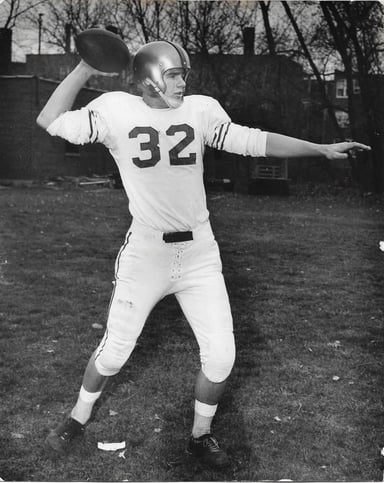
Phil Johnson“As to the combative part of football, that is typical of human activity. We turn God’s quest for harmony into combative violence, even though we can sometimes move toward a more peaceful and harmonious relationship. Notice how we flock to see violence and are bored by harmony.”

United’s student coaches were Mike and Phil, both of whom had played football collegiately—Mike at Hanover College in Indiana, where he was a co-captain of the team, and Phil at North Park College in Illinois (see photo at right).

Mike and Phil also determined the positions that each team member would play on offense and defense. Because they only had 11 players, each player needed to play at least two positions. According to Phil, who played quarterback and defensive tackle, “That’s the way to have fun!” Ted, an offensive and defensive lineman, didn’t remember it quite the same way. “I was running for my life!” he asserted last year.
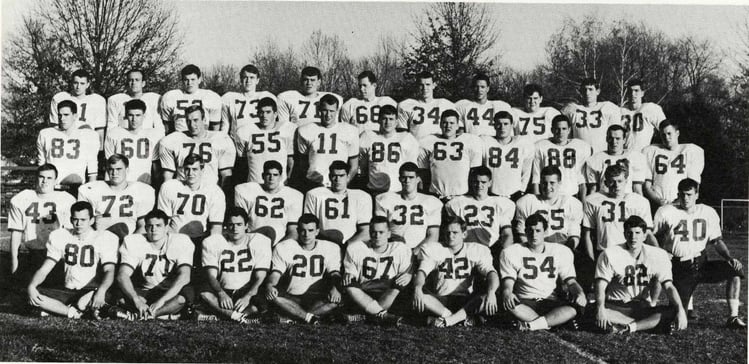

Hanover College 1964 Football Team Groh 86

This 1964 photo from Hanover College in Indiana shows #86, Mike Groh (’69)—a team co-captain—in the third row toward the center.
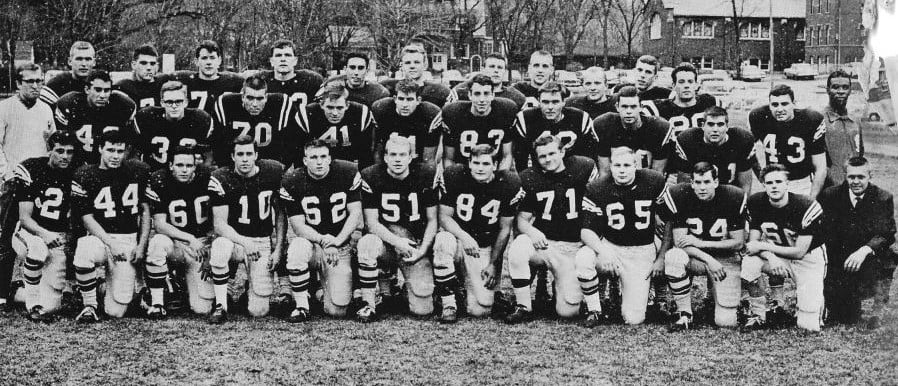
ElmhurstFootball1965 Cropped

This 1965 photo from Elmhurst College in Illinois (Reinhold and H. Richard Niebuhr’s alma mater) shows three of United’s football players: in the first row are #44, Rich Grobe (’72),  and #51, Gary Miller (’68); #70, Hal Schippits (’69), is the third player in the second row.


Game One at Stillwater Prison
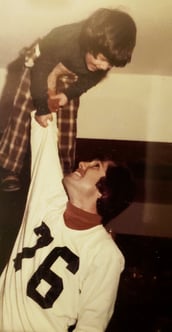
Ted and child jersey 76The Prison Mirror, a newspaper produced by inmates at Stillwater Prison since 1887, ran this headline in its October 20, 1967 edition: “Preachers Chill Colts.” The story began, “A good team from the United Theological Seminary combined an excellent passing and running attack to defeat the Colts in the rain by a score of 20–13.”

Highlights of the game included two key interceptions by Mike, a fumble recovery by Ted, and a lot of running (with judicious passing on occasion) by Phil, the quarterback. Ted remembers that when he recovered the fumble, he heard Mike yelling, “Get up and run! It’s a live ball!” By then, however, the Colts had covered him.

Ted still has the number 76 jersey he wore in that first game (see photo at left). “I kept that jersey as a survival trophy,” he explains.

Games Two and Three

According to Phil and Ted’s research, the Colts team routed United in the second game of 1967. As they wrote, “Our understaffed team was no match for ‘Ron the Bomb’ Holmes, who ran through and past us for 263 yards.” Rumors were that Holmes had been released from solitary the day before and was very keen to get out and run.
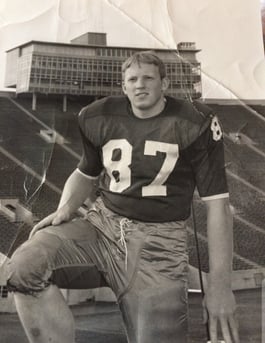
Ken GrohBy the fall of 1968, when United played its third and final game at Stillwater prison, United’s roster had grown to 15. One of the 15 was Ken Groh, Mike’s brother, who, Ted asserts, “had never darkened the door of a seminary classroom.” Ken had, however, played football at Indiana University (see photo at right) and was a welcome addition.

Highlights of that third game included United’s successful two-point conversion after their first touchdown, and a fumble recovery to keep the Colts out of the end zone. Phil took the ball in for United’s next touchdown and a second two-point conversion. Ultimately, the Colts came within one point of tying the game, and the final score was 22–21. Thank goodness for those two-point conversions!

The Prison Mirror article from the game concluded with this sentiment: 

“A salute to Head Coach Donald White and his fine crew that he brought in, who, along with the Colts, played an extremely clean game of football. We’d like to note also that most of the players from the United team played offense and defense, and one in particular, Steve Steiner* (’71), who played despite a broken tooth and having the wind knocked out of him; he also scored the first touchdown for United.”

Breaking Bread Together

After the first game at Stillwater Prison, representatives from both teams met in a small dining room for a meal. Ted remembers that “conversations were animated, much of it focused on game highlights.” The men also swapped stories about their lives and dreams for the future.

During the meal and through the conversations, stereotypes on both sides began to dissolve. Phil and Ted note, “Inmates were tough guys, but they had families, thoughts, senses of humor, and feelings. For their part, seminarians were regular guys who weren’t afraid of a tough game, and were taking time to visit men in prison and share a meal.”

Ultimately, the games and meals, Ted and Phil share, “were a true example of what United preached as being open and responsive to others. It was a valuable lesson.”

Postscript

Despite their success on the gridiron, not one of the seminary players took up football as a career. Phil finished his seminary degree at Andover Newton and held several jobs, including pastor. He also founded and edited the journal Pietisten for 24 years. Mike spent his life working in and consulting with nonprofit organizations and developing community leaders. During his career, he worked with 500 groups in North America, Eastern Europe, and the Balkans supporting food security, environmental groups, and NGOs in nations with emerging democracies.
VinceCarrollThrough Mike, Ted got a job at the University of Minnesota as a chemical dependency instructor. Since finishing his MPH at the University, he has worked for a variety of healthcare companies, primarily in sales. He is currently the senior vice president for national sales at Welvie, a company that offers online learning programs to help people make more informed decisions about their care options.

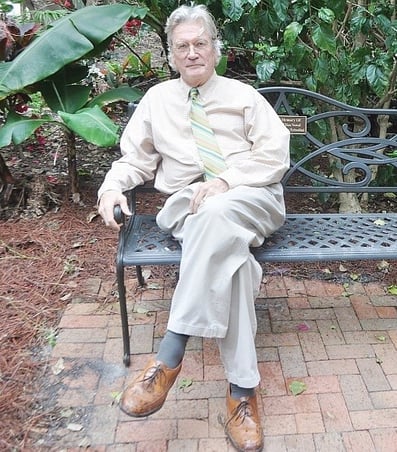
Vince Carroll (’71, pictured at left) was the last Protestant chaplain ordered “in-country” with the Major Marine Corps Unit, working with Force Logistics Command and supporting troops in Vietnam from Phu Bai to the DMZ. Hal Schippits (’69) served as a UCC minister in Minnesota’s National Guard and then directed Hennepin County’s Day Treatment and Dual Diagnosis programs.

Gary Miller served as a military chaplain too, but spent most of his life as a UCC pastor. Stephen Steiner and Rich Grobe (’72) were also UCC pastors. Don Miller (’71)—the team’s center, long snapper, and place kicker—went on to earn a DMin from Eden Theological Seminary and spent many years in parish ministry.

Closing Thoughts

As Ted reflects: 

“During my four years at United, there were a number of events that bound the community together and spoke to the words in Matthew 36:25. Given the uniqueness of the prison football experience, it was perhaps the most dramatic expression of ‘social gospel’ at the time, but [very much in keeping with] the ‘social gospel’ espoused by the seminary. The United football team in the late 1960s perfectly exemplified our classroom lessons and I’ll be forever grateful for my seminary experience.”

Phil adds, “I definitely agree with Ted. United was intentionally a wide-open place. There was no lid on the freedom to try things.”
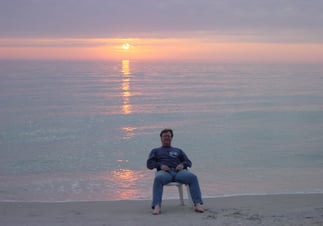
dadsunset2croppedUnited is delighted to be able to share a story about the remarkable 1967–1968 football program and honor the players who invested their faith and risked their limbs in the process. We owe Ted and Phil credit for drawing our attention to their story and conducting important research, and are delighted that Professor Emeritus and coach Don White was able to give us a primer on process theology and football. Thanks also to Alicia Groh, Mike’s daughter, who tracked down photos of her dad (including him on the beach at sunset) for this article.


* Deceased

Explore More Articles

Rev. Dr. Molly T. Marshall to Retire in 2027 Following Six Exemplary Years as President

Her Vision and Leadership Have Transformed United Following six historic and transformative years as President of United Theological Seminary of the Twin Cities, Rev. Dr. Molly T. Marshall will retire on June 30, 2027, upon completion of the seminary’s 65th academic year. President Marshall secured United’s financial standing, advanced institutional objectives toward long-term sustainability, and catalyzed historic growth in institutional fundraising and student enrollment. Rev. Dr. Marshall assumed her role as Interim President in March 2021 following thorough vetting by a search committee and the Board of Trustees’ unanimous vote. Having served in theological education for more than 40 years, her reputation preceded her. She made headlines as the first woman appointed to the School of Theology at Southern Baptist Theological Seminary, the flagship school of the Southern Baptist Convention. Ordained as a Southern Baptist, she later received the privilege of call by the American Baptist Church.  In 1997, she joined the faculty of Central Baptist Theological Seminary as professor of Theology and Spiritual Formation, thereafter stabilizing and revitalizing the school as President from 2004 to 2020, becoming the first woman ever to lead a Baptist seminary or divinity school. President Marshall’s respect and renown culminated in her executive report on effective seminary leadership, written for The Association of Theological Schools (ATS) before she arrived at United. Her experiences as a congregational minister, feminist theologian, prodigious academician, and her achievements as an administrator in theological education augured well for the seminary’s future in her care. Less than a year later, her position was made permanent, formally making her United’s tenth president, and, desiring to honor United's legacy, she pursued and received clergy standing with the MN United Church of Christ. United trustees outlined a set of priorities at the beginning of President Marshall’s tenure, on which she began immediate work. She invested much of her first several months in office in forming connections with alums, donors, and faculty. She concentrated her relational acumen on Advancement, and donors responded enthusiastically. In September 2021, United announced the Johnson-Fry Chair in World Religions and Intercultural Studies, endowed by Rev. Dr. Andrea Johnson (’17, ’23) and David Fry. Cultivating “respect for the lived religion of others,” as President Marshall often asserts, is a pillar of her scholarship and the seminary’s academic ethos. The Sophia Chair in Religious and Theological Studies, funded by a generous gift from Dr. Mary Farrell Bednarowski—Professor Emerita of Religious Studies (1976–2004)—and her husband and former trustee, Keith Bednarowski, followed in 2024. Finally, in 2025, a cadre of friends, alums, and former faculty established the Wilson Yates Chair in Theology and the Arts. These chairs, paired with substantial growth in endowed scholarships, feature prominently in President Marshall’s legacy and will endure as a witness to her faithful stewardship of alum and donor relations. Rev. Dr. Cindi Beth Johnson, Vice President for Advancement, reflects, “President Marshall’s enthusiasm, attention, and engagement with our donors have been important components of her leadership. She has honored our alums and delighted in our students. Molly has valued United’s history even as she has led us into new ways of being. She has built a culture that reflects her dedication, vision, and generosity. She has been a bright light in the broader community, embodying her passion for and dedication to United. Molly arrived with both expertise and heart, and she has shared them generously. She leaves a lasting imprint, and we are better for that. On a personal note, it has been a great gift to be her colleague.” Historic enrollment has been a fixture of President Marshall’s tenure. Between fall 2020 and fall 2025, degree-seeking student enrollment grew 57 percent, with the seminary welcoming its largest incoming class of degree-seeking students ever in fall 2025. In a climate where many theological schools have experienced stable or declining enrollment, United has surged. The Association of Theological Schools (ATS), one of the seminary’s two accrediting bodies, named United in its 2023 Holiday Colloquy Online issue as one of only 18 ATS-accredited seminaries to have demonstrated “steady year-over-year growth during the past five years.” President Marshall has positioned United as a leader in progressive theological education and a model for historically Mainline Christian schools. Commenting on what makes the seminary unique, President Marshall astutely noted United’s “desirable curriculum that emphasizes social transformation, theology and the arts, interreligious engagement, and public theology” and the intentional welcome of “students with myriad religious, spiritual, and theological leanings.” She sharpened and raised the seminary’s prophetic voice, believing that progressive theological education exists to serve the common good. From considerable growth in the Interreligious Chaplaincy program to the establishment of the Sims Scholars Initiative, she has expanded the student body’s depth and breadth. Under President Marshall’s fastidious leadership, United completed a Five-Year Strategic Plan in 2026. David S. Anderson, former Chair of the Board of Trustees (2020–2026), witnessed firsthand President Marshall’s effective management of United’s revitalization and her manifold accomplishments in office. On his close friend and colleague, David writes, “In her writings, President Marshall, Molly to me, once observed, ‘. . . following the Spirit will require of all of us faith—all the guidance we usually get is enough to take the next uncertain step.’ United, in late 2020, was indeed in a state of uncertainty, and President Marshall’s emergence as its next president must be seen as a revelation of the Spirit. She has led United to a platform of stability from which it will move forward with confidence, heeding the Spirit toward an uncertain, as human endeavors are, but bright and sustainable future.” Dr. Kyle Roberts, Dean and Vice President for Academic Affairs, shared the news of President Marshall’s retirement with students this morning. With profound gratitude for her enrichment of the seminary’s faculty and scholarship, he remarked, “President Marshall has been just the leader this seminary needed to reclaim its vision, its vibrancy, and its voice in theological education. She has led a process of internal healing and of increasing external influence. She has been a champion of rigorous but applied theological education for spiritual leadership, supporting and encouraging the faculty in their teaching and the staff in their work. United,” he affirmed, “will always be indebted to her years of service and to her passion and care in moving the seminary to its next stage. United is, once again, a leading voice in progressive seminary education in large part because of President Marshall.” Rev. Dr. Dianne Oliver, Chair of the Board of Trustees, celebrates President Marshall’s transformative tenure and looks toward a bright future ahead. She affirms, “President Marshall’s impact on United is really extraordinary, and she will leave a profound legacy at the institution. Clearly, she has been successful in the ways often highlighted for an outstanding President—record enrollment, expanded academic programs, and financial stability, building a strong foundation for the next steps on United’s journey. Add to these leadership successes Molly’s theological acumen and prophetic voice in challenging times, and it is easy to see the scope of her leadership. Just as importantly, though, Molly has helped create a deep sense of community among the faculty, staff, students, trustees, and the broader community who support the work of United. Her leadership and accomplishments ensure United will keep living into the fullness of its mission and vision as the context for theological education continues to evolve.” Reflecting on her service to the seminary, President Marshall writes, “Serving as United’s President has been a joyful pursuit over these past several years as I have lived into the storied history of this good seminary. I have been invited into a theologically expansive landscape where courageous learning and creative ministries have renewed my own vocation in theological education.” She continues, “Faculty, staff, students, board members, donors, and friends have welcomed me to help craft this chapter of our shared mission. I could not be more grateful for the opportunity to serve as United’s tenth president. (Don’t say goodbye to me yet; there’s still work to be done!)” A Presidential Search Committee, comprised of trustees and representatives from the student body, alums, faculty, and staff, has been engaged in faithful preparation ahead of the public search for President Marshall’s successor. The seminary will share details about this process in the days ahead. Friends and colleagues from throughout President Marshall’s career were invited to submit reflections in her honor. These have been published on our announcement page. United eagerly anticipates celebrating President Marshall and her myriad contributions to the life of the seminary community during special events in spring 2027. Details will be made available in the months ahead. Strengthened and invigorated by President Marshall’s faithful leadership over these six years, United enters its 65th year of progressive theological education, steadfast in its mission: preparing innovative and compassionate leaders for the equipping of churches, other faith communities, and society toward justice and peace. Honoring President Marshall In celebration of President Marshall's tenure, a webpage featuring images, reflections by friends and colleagues, and opportunities to honor her achievements is now available. Visit the link below to learn more. Learn More About United Founded by the United Church of Christ (UCC) as a welcoming, ecumenical school that embraces all denominations and faith traditions, United Theological Seminary of the Twin Cities has been on the creative edge of progressive theological thought and leadership since it was established in 1962. Today, United continues to educate leaders who, through the eyes of faith, engage in the dismantling of systems of oppression, exploring multi-faith spirituality, and pushing the boundaries of knowledge. Media Contact Nathanial Green (he/him) Director of Marketing and Communications press@unitedseminary.edu • 651.255.6138

St. Mark’s UCC Gifts an Endowed Scholarship to United

United graduates have an impact on United in countless ways. President Molly T. Marshall notes that they are, in fact, our letters of recommendation. They embody the educational experience they had at United in the work they pursue, in how they live out their faith traditions, and in the impact they have in the world.  We see this in myriad ways. There is the alum who is a recurring donor and the alum who creates a legacy gift to support future students. There is the alum who introduces President Marshall to a new donor. And there is the alum who sees another person’s interest in theological education and encourages them to pursue a degree at United. Recently, we have seen up close the impact of the work of Rev. Jennifer Jaimez (’98). Jennifer’s first call was to St. Mark’s UCC in Bloomington, Minnesota, which was founded in 1954. Jennifer served at St. Mark’s for 28 years and, like other pastors, she had a significant influence on members and the broader community. St. Mark’s also had an impact on United. During Jennifer’s ministry, eight students from United completed nine-month internships at St. Mark’s. As interns, these students were part of a learning community that helped them hone skills in teaching, preaching, counseling, and administration. The congregation, along with Jennifer, mentored and encouraged them. They have all gone on to do a multitude of things: serving in nonprofits, rural churches, city churches, and more. St. Mark’s investment in United students had a significant impact.  As for many congregations, the pandemic was difficult for St. Mark’s. Three years ago, they made the painful decision to complete their ministry and intentionally repurpose their assets while it was still their choice. In addition to supporting the Minnesota Conference UCC and the Bloomington Housing and Redevelopment Authority, they made a significant gift to United. A relationship that began with mentoring interns grew into a newly endowed UCC scholarship. The St. Mark’s endowed scholarship will provide financial support for UCC students who wish to attend seminary. This gift creates an enduring legacy for St. Mark’s and will provide support for future students. As the gift was announced, their moderator, Cindy Russell,  said, “This gift will defray the cost of seminary education. Support for future leaders of the church remains important as the church continues to evolve into new ways of being the church.”  This spring, we have been blessed to establish several new endowed scholarships in addition to the one from St. Mark’s. Estate gifts from Joanne* (’82) and Thomas* Rohrict, and Elden* (Yankon, ’55) and Norma* Zuern have created a lasting legacy and investment in United. A recent gift from George (Mission House, ’55) and Joyce Schowalter will allow them to see, while they are living, the impact of scholarship support. Currently, 57 percent of scholarships are covered by generous gifts and endowed scholarships. The other 43 percent is paid out of United’s annual budget. Each scholarship gift, each new endowed scholarship, or gift to an already endowed scholarship, helps us expand offerings to our students. We don’t want financial limitations to become a barrier for students who feel called to attend United.  Your scholarship gifts supported Jennifer while she was a student. Her experience at United, along with the skills she has learned along the way, helped her shepherd St. Mark’s for more than two decades and through the difficult decision to complete their ministry. Your gifts to United continue to make this happen. We give thanks for the lasting legacies created by these and many other faithful donors.  __________________________ * Deceased

Alum Rev. Todd Lippert (’03): Living a Public Ministry

As Rev. Todd Lippert was growing up, his life was dominated by two constants: music and church. Both of his parents were music teachers. His dad was the high school choir director, and his mom was the elementary school music teacher. Though his family had been Baptist for generations, they ended up attending a United Church of Christ (UCC) church where his mom was hired to play the organ. It was also much closer to home than the nearest Baptist church.  “I always took Christian faith very seriously,” Todd asserts. “The church was a sacred and holy place to me.” In seventh grade, Todd remembers talking to his father. “I was at the bottom of the stairs talking to my dad at the top of the stairs. And that was when I said for the first time, ‘I wonder if I might want to be a pastor someday.’”  But, Todd adds, “the idea was really terrifying to me,” so he put it out of his mind. At the University of Iowa, he pursued a music degree. During a philosophy class toward the end of college, a professed atheist professor began asking some of the same questions about faith that Todd was confronting. “I was wrestling with whether I was a Christian or not.”   Deciding on Seminary The turning point came one Sunday morning after graduation when Todd and his wife were at church. At the time, he was selling Yellow Pages ads and contemplating an MBA. “I hated it,” Todd confesses. “I was miserable.” Watching the preacher at First United Methodist Church in Iowa City, he thought, “Maybe I could do that, and maybe I need to pay attention to this call to ministry that keeps bubbling up.” United was the first UCC seminary that came up on the computer, and when Todd visited, “it felt like home for me as soon as I arrived.” Since his wife was doing graduate work at the University of Minnesota, they moved to the Twin Cities.  “At United,” Todd recalls, “I had the space to figure out how Christianity was meaningful and how this faith fit together for me.” Professors who welcomed and encouraged his questions were key to his faith formation, and the “liberation theology that moved through the curriculum, with its focus on justice, was extremely appealing to me.”  Todd was also inspired by his classmates. “I saw the student body deeply engaged in the political and social questions of the day.” At United from 2000 to 2003, Todd experienced the Bush v. Gore lawsuit, 9/11 terror attacks, Minnesota senator Paul Wellstone’s tragic death, and the Iraq war launch as he was earning his MDiv.    Public Theology Justice-seeking activism, Todd asserts, “really cemented my understanding that the body of Christ is about bringing the realm of God into being wherever it is. And that was something that would have to make my life better and make my community better.” Since graduating, Todd has worked as a UCC pastor, a Minnesota state legislator (2018–2022), a community organizer with ISAIAH, and a community minister with Creekside Church. The clergy organizing work during Operation Metro Surge was especially impactful and reconnected him with United. Todd went through “nonviolent direct action training with Dr. Rita Nakashima Brock, one of the authors I read.” He also worked with Rev. Dr. Carolyn Pressler, his former Hebrew scripture professor.  United, notes Todd, equipped him “to be able to understand what is going on in our world, and in our communities, and I had the tools to get better and better at that, reading the present through a biblical and theological lens.” He is extraordinarily proud of the way the church showed up in Minnesota and grateful for United. “I really want,” Todd concludes, “the love-your-neighbor values of the church to be a force in our public life, not an afterthought. I want it to be a force in our political life.”