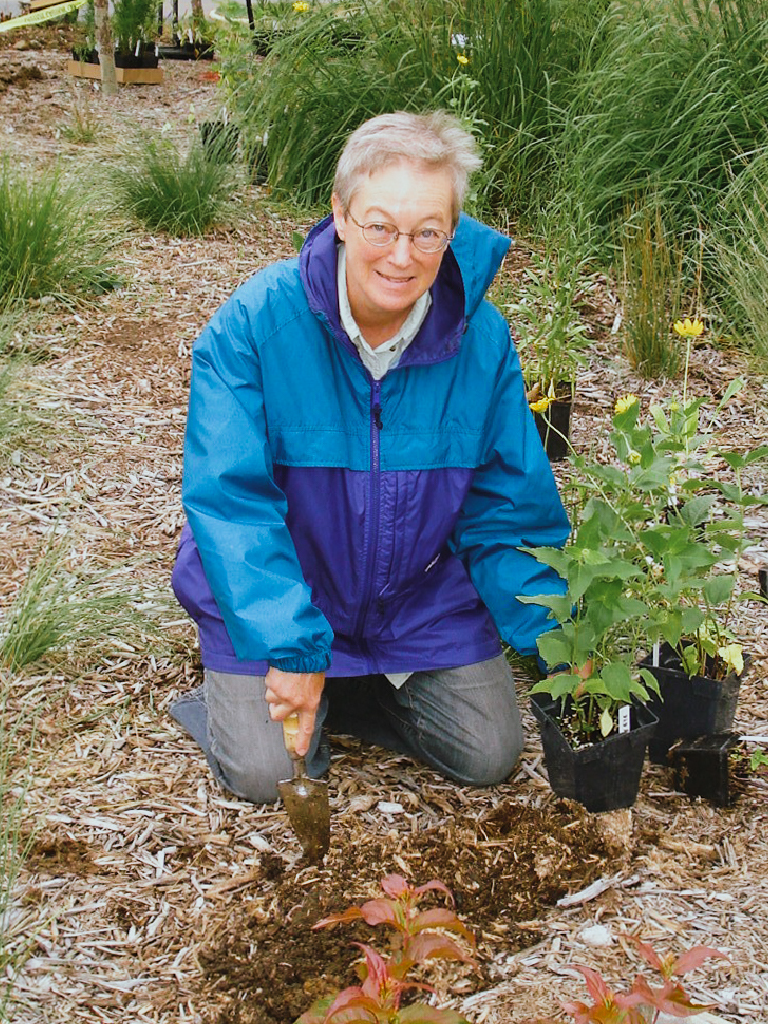
The Living Legacy of Dr. Judith Scoville

Alums Ecology Ethics

“We’ve got to get you a Presidential scholarship,” Dr. Mary Farrell Bednarowski urged the prospective student in an interview. “Does this mean I’ve been admitted?” the interviewee asked.

This is how Dr. Judith Scoville (’90) received a gift that would shape her life and, through her reciprocated generosity, reverberate decades later in the lives of new generations of United students. It was, in her words, “the biggest academic honor I’d ever received.” 

Judith came to United after several years in an Education for Ministry program facilitated by an Episcopal seminary. The Education for Ministry program was predicated on asking, “What are we called to do? What is our ministry?” At the time, Judith was working for “not a very ethical company,” she quipped, but this experience sparked her interest in and passion for ethics. “I was in St. Luke’s Episcopal Church,” Judith recalls, “and for four years… it was a small group of us [that] met every week,” studying Scripture, theology, and church history. Nearing the end of the program, the associate minister remarked, “maybe I should go to United.” For Judith, “Coming to United was part of pursuing that question of ‘what is my ministry?’”

After graduating from United in 1990, Judith began pursuing her PhD in ethics at the Graduate Theological Union. While there, she taught Christian ethics at United as an adjunct professor. A student, friend, and mentee of Dr. James B. Nelson, Professor Emeritus of Christian Ethics (1963–1995), Judith discovered her ministry as an educator. “My students were so special,” she remarks. “I found at United that… if you ran a class so that you were providing students with an opportunity, …they will become a part of shaping the class and making it what it is.” She avers, “You don’t just pour information [into] United students.”

Judith later became an associate professor and the Hulings Distinguished Chair in the Humanities for Northland College. She gave United’s first-ever Picard Lecture on Environmental Theology and Ethics, and her participation in the life of the seminary spans decades. From alum to professor to donor, her contributions to the United community are hard to overstate.

Now in her mid-80s, Judith—as quick-witted and incisive as ever—is crafting a living legacy. Since the death of her husband, Dr. James (Jim) Scoville, Judith has committed to using her resources for good. Ever conscious of ethics, it became, in her mind, “a moral obligation” to give back. And so, Judith brought her scholarship experience full circle by recently making a significant gift to United’s endowed scholarship fund, securing access to the transformative power of theological education for future students. She is quick to note, “To me, it does not feel like generosity.… It’s what I want to do.” She feels “an ethical obligation” to use her money to build a better society, “richer in all the things that count.”

“I don’t want the ability to go to United to be limited by the ability to pay,” she asserts. “I want everybody who… wants to be part of this community to be able to do that no matter what their finances are.” She knows it will “enrich United to have as broad a variety of students as possible,” and that if “we’re all white middle-class people, then it’s a very impoverished community.”

Judith and Jim are also celebrated members of the Barnabas Society, which honors individuals who include United in their estate plans or make other qualifying gift arrangements. Asked why others should consider making a gift, she thoughtfully reflects, “It’s a very satisfying thing to give to United. It makes me feel like I’m doing something positive and constructive.” She continues, “I’m proud of the results that I see at United.… It makes me happy.” We give abundant thanks for the vibrant, living legacy of Judith Scoville.

Explore More Articles

Alum Rev. Todd Lippert (’03): Living a Public Ministry

As Rev. Todd Lippert was growing up, his life was dominated by two constants: music and church. Both of his parents were music teachers. His dad was the high school choir director, and his mom was the elementary school music teacher. Though his family had been Baptist for generations, they ended up attending a United Church of Christ (UCC) church where his mom was hired to play the organ. It was also much closer to home than the nearest Baptist church.  “I always took Christian faith very seriously,” Todd asserts. “The church was a sacred and holy place to me.” In seventh grade, Todd remembers talking to his father. “I was at the bottom of the stairs talking to my dad at the top of the stairs. And that was when I said for the first time, ‘I wonder if I might want to be a pastor someday.’”  But, Todd adds, “the idea was really terrifying to me,” so he put it out of his mind. At the University of Iowa, he pursued a music degree. During a philosophy class toward the end of college, a professed atheist professor began asking some of the same questions about faith that Todd was confronting. “I was wrestling with whether I was a Christian or not.”   Deciding on Seminary The turning point came one Sunday morning after graduation when Todd and his wife were at church. At the time, he was selling Yellow Pages ads and contemplating an MBA. “I hated it,” Todd confesses. “I was miserable.” Watching the preacher at First United Methodist Church in Iowa City, he thought, “Maybe I could do that, and maybe I need to pay attention to this call to ministry that keeps bubbling up.” United was the first UCC seminary that came up on the computer, and when Todd visited, “it felt like home for me as soon as I arrived.” Since his wife was doing graduate work at the University of Minnesota, they moved to the Twin Cities.  “At United,” Todd recalls, “I had the space to figure out how Christianity was meaningful and how this faith fit together for me.” Professors who welcomed and encouraged his questions were key to his faith formation, and the “liberation theology that moved through the curriculum, with its focus on justice, was extremely appealing to me.”  Todd was also inspired by his classmates. “I saw the student body deeply engaged in the political and social questions of the day.” At United from 2000 to 2003, Todd experienced the Bush v. Gore lawsuit, 9/11 terror attacks, Minnesota senator Paul Wellstone’s tragic death, and the Iraq war launch as he was earning his MDiv.    Public Theology Justice-seeking activism, Todd asserts, “really cemented my understanding that the body of Christ is about bringing the realm of God into being wherever it is. And that was something that would have to make my life better and make my community better.” Since graduating, Todd has worked as a UCC pastor, a Minnesota state legislator (2018–2022), a community organizer with ISAIAH, and a community minister with Creekside Church. The clergy organizing work during Operation Metro Surge was especially impactful and reconnected him with United. Todd went through “nonviolent direct action training with Dr. Rita Nakashima Brock, one of the authors I read.” He also worked with Rev. Dr. Carolyn Pressler, his former Hebrew scripture professor.  United, notes Todd, equipped him “to be able to understand what is going on in our world, and in our communities, and I had the tools to get better and better at that, reading the present through a biblical and theological lens.” He is extraordinarily proud of the way the church showed up in Minnesota and grateful for United. “I really want,” Todd concludes, “the love-your-neighbor values of the church to be a force in our public life, not an afterthought. I want it to be a force in our political life.”

Rev. Dr. Andrew Packman Promoted to Associate Professor of Christian Ethics, supported by the McVay Endowment

Saint Paul, Minnesota, United States, June 24, 2026 —United Theological Seminary of the Twin Cities is delighted to announce that, effective July 1, 2026, Rev. Dr. Andrew Packman will become the Associate Professor of Christian Ethics, supported by the McVay Endowment, and Director for Formation. This promotion to an endowed chair follows Rev. Dr. Justin Sabis-Tanis’ appointment as the inaugural Wilson Yates Chair in Theology and the Arts. Announced during Commencement in April, the McVay chairship reflects the esteem with which United’s board and faculty members regard Professor Packman. In February, Dean Kyle Roberts proudly reported that Dr. Packman was being promoted from assistant to associate professor and transitioning from a three-year contract into a tenure-track position. Dr. Packman joined United in July 2021 as a Louisville Institute Postdoctoral Fellow and Visiting Assistant Professor of Theological Ethics and Practical Theology. At the Spring 2022 Convocation to welcome and bless our new faculty member, Dr. Packman—who holds an MDiv and PhD from the University of Chicago—presented on “The Atmospherics of Theological Education.” By December 2022, Dr. Packman’s “teaching, mentoring, and other stellar capabilities” prompted United to offer him a contract to continue teaching past the terms of his Louisville Fellowship. Since then, he has co-authored an article in The Oxford Handbook of Friedrich Schleiermacher, had a paper (“The Consolation of Studying Theology”) published in the Christian Century, and presented at the September 2025 Schleiermacher Kongress in Kiel, Germany. Spiritual and personal formation is a vital component of Packman’s work with students, and he will continue in his role as the director for Formation. In May of 2025, he began a new initiative, the Formation Pilot Program, to gauge the foundational axis points of students’ formation at United. “This is a remarkable moment in theological education,” Dr. Packman explained this spring, “where what it means to be a theological learning community is being reimagined in real time. This pilot program is designed to interrogate this question from across the life of the seminary, and to build up our community in the process.” “Dr. Packman’s doctoral studies,” observed Dean Roberts in his April announcement, “focused on Christian theology and ethics, and his current research explores questions about racism, intransigent evil, and Friedrich Schleiermacher’s philosophical and theological ethics. Combined with his MDiv studies in pastoral formation, these make Dr. Packman well-suited to occupy this chair while he continues…serving as the Director for Formation.” President Molly T. Marshall reflects, “Dr. Packman brings academic excellence and pastoral sensitivity to his teaching, collegial relationships, and community involvement. His theological depth suffuses his courses in ethics and formation, seeking to form good human beings as transformative agents for a world in travail. I am delighted by this appointment.” As Dr. Packman shared when he was offered a chance to continue teaching at United past his Louisville Fellowship, “It’s such an immense gift to get to do this work, and it’s an honor to get to do it with folks like you. I’m so eager to see what we build together!” Now, as a new chapter begins with his elevation to the McVay Chair, we are overjoyed that such a prodigiously talented scholar and teacher can continue to journey with our dedicated and curious students. About United Founded by the United Church of Christ (UCC) as a welcoming, ecumenical school that embraces all denominations and faith traditions, United Theological Seminary of the Twin Cities has been on the creative edge of progressive theological thought and leadership since it was established in 1962. Today, United continues to educate leaders who, through the eyes of faith, engage in the dismantling of systems of oppression, exploring multi-faith spirituality, and pushing the boundaries of knowledge. Contact Nathanial Green (he/him) Director of Marketing and Communications press@unitedseminary.edu • 651.255.6138 Admissions and Enrollment admissions@unitedseminary.edu

Rev. Dr. Tim McGregor (’26) Finds Hope for Healing in Exploratory Theology

Rev. Dr. Tim McGregor (’26) has been a chaplain, pastor, and church planter for years. How did he find this well-trodden path? Tim says his mother introduced him to Christ. “She was very devout,” he explains. Unfortunately, she was also very sick, so Tim spent more time in hospitals than in church as a child. Still, he recalls one incident during communion when he was 11. Tim shares that he “had a very out-of-body experience with the divine while I was in church, and it touched my soul.”  Tim grew up and pursued a BA at Tuskegee University. While there, he experienced another out-of-body experience when he was robbed at gunpoint and stabbed. “At that point,” he reflects, “I decided to rethink some of my living and some of my decisions. It reignited my spiritual walk.”  As he changed the way he lived, Tim felt a spiritual nudge. Others observed that they “saw the calling” on his life. And dreams about preaching began to recur. “Before I ever preached a sermon, I dreamed I was preaching…in the same church where I ended up preaching later on.”   Christian Theological Seminary Though Tim identified as National Baptist, he decided to attend Christian Theological Seminary (CTS) in Indiana—a progressive school aligned with the Christian Church (Disciples of Christ). It helped that Dr. Edward Wheeler, an ordained Baptist minister whom Tim knew when Wheeler worked at Tuskegee, was CTS’s president. During a United chapel service this March, Tim described his experience at CTS as “quite grueling,” but also that he “learned a lot.” As he clarified more recently, he had to “let go of a very fundamentalist perspective,” and that sort of deconstruction was difficult. “It was a crucible situation,” Tim asserts.    Chaplaining and Church Planting After earning his MDiv in 2003, Tim spent years in Mississippi and Texas planting churches and working as a hospital chaplain. Since returning to Minnesota, he’s been a chaplain at Regions Hospital, Abbott Northwestern, and the Minneapolis VA Medical Center, and pastored at Family Bible Church. He suspects that the time he spent with his mother in hospitals likely inclined him toward hospital chaplaincy.  When he decided to pursue a DMin, Tim reviewed his options. Only United, he found, had the interreligious chaplaincy program and liberal ethos that made his MDiv work transformational. Plus, he could attend onsite or online as his schedule allowed. “It was a great benefit,” Tim attests, “to do both.”   United and Nat Turner  Tim credits Dr. Jessica Chapman Lape, former director of the Interreligious Chaplaincy program, with positively shaping his education. Her theological knowledge and emphasis on her African American heritage impressed him. Dr. Munjed Murad’s Comparative Theology course elevated Tim’s intercultural acuity. Munjed is an assistant professor of World Religions and Intercultural Studies, supported by the Johnson-Fry Endowment.  Tim describes his dissertation, “The Exploratory Theology of Nat Turner and Its Effects on African and African American PTSD,” as “a labor of love.” Why Nat Turner? “I appreciate his passion and his desire to live and fight for the rights of his people,” Tim explains, “and his willingness to do so in the name of his religious beliefs.” In addition, “I’m always interested in people that…have been misunderstood or written off as villains.”  Shepherded with vital support from Rev. Dr. Andrew Packman (assistant professor of Theological Ethics and Formation), Tim’s dissertation studies Nat Turner, his traumatic experiences as a slave, and his burgeoning theology. It also traces links to the moral injury, trauma, and PTSD endemic to military service, especially for African American veterans.  Tim wants to “understand more about…how to be an asset to my community.” He feels that “United was a really good place for that” and is a rich resource for “clergy…and spiritual caregivers” who are going to help us “keep pressing toward better understandings.” Tim is grateful for United’s role in honing his academic and spiritual voice.