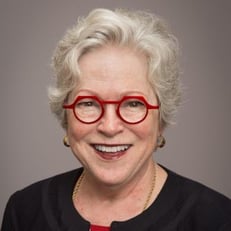
 When United President Molly T. Marshall joined the Collegeville Institute board in 2023, she joined the august company of many United administrators, faculty, and alums who have also served on the board and in other capacities over the years. These connections, spanning decades of cumulative involvement, illustrate values rooted in accordant religious objectives.
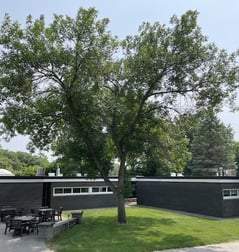 Collegeville Institute is irrevocably tied to its location. It anchors its ecumenical core in a setting that cannot help but evoke visceral rapture at the soothing call of nature. It was constructed with walls of windows on the shores of Stumpf Lake by the Hungarian modernist architect Marcel Breuer, who had designed Saint John’s Abbey a few years before. As the Institute’s written history attests, “The cry of loons was considered a fitting, even necessary, backdrop to the work to be done.”
.png?width=284&height=213&name=Web%20banner%20(476%20%C3%97%20357%20px).png) United, born out of the United Church of Christ (UCC) and grounded in the urgent needs of an ever-changing world, continues to confront forces that would reject Christ’s call for justice, peace, and belonging for all of creation. Our setting, inside an old industrial building at the heart of the urban Twin Cities, and scattered world wide through distance learning, relies on relationships, scholarship, art, expression, and hope.
United, born out of the United Church of Christ (UCC) and grounded in the urgent needs of an ever-changing world, continues to confront forces that would reject Christ’s call for justice, peace, and belonging for all of creation. Our setting, inside an old industrial building at the heart of the urban Twin Cities, and scattered world wide through distance learning, relies on relationships, scholarship, art, expression, and hope.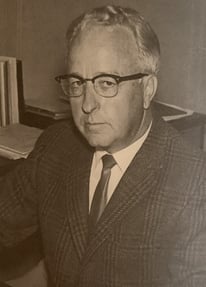 In a eulogy penned November 2, 1989, by H.C. Piper, Jr.—chair of Collegeville Institute’s board of directors and a United alum (’74) and supporter—the Institute mourned “the death on the Eve of All Saints of Louis Gunnemann, a charter member of the Institute’s Board of Directors.” Dr. Gunnemann, who served as dean at Mission House and at United, also supported the founding of Collegeville Institute. “Louis understood from the beginning,” Piper wrote, “how the Institute’s special genius depends on its being independent while at the same time drawing sustenance from the work and worship of the Benedictine community.”
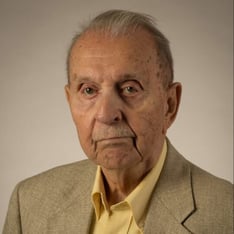 Rev. Dr. Clyde Steckel, who joined United’s faculty in 1970, knew about Collegeville Institute while in ministry at the University of Minnesota. In 1983, he became a resident scholar at the Institute while on sabbatical from United. In 1993, he joined the Institute’s board. Steckel suggests that it was easy to serve United and the Institute because there was no conflict of interest. “Both organizations,” Steckel explains, “had a similar mission and purpose: nontraditional, theological education.” Besides, he adds, “We all like to get out in the woods and by the lakes.”
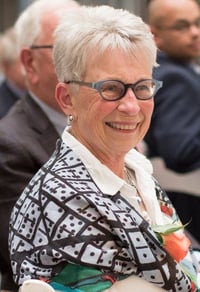 Dr. Mary Farrell Bednarowski, who covered Steckel’s sabbatical at United, was enticed to attend a luncheon for the Institute by acting United president Rev. Dr. Molly McMillan, one of the Institute’s founding board members. She’s been a supporter ever since. In 1990, Bednarowski was invited to be part of a three-year summer consultation. In 1996, when McMillan asked if she would join the board, Bednarowski remembers, “It took me about 30 seconds to say yes.” She adds, “I think of the Institute itself as a magical place, and that is also how I feel about United. The ‘magic,’ as I have experienced it in both places, is a gift freely offered to all who enter.”
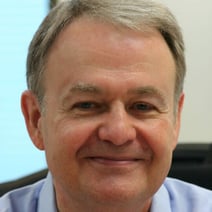 McMillan also invited Rev. Dr. Gary Reierson (a 1978 and 1986 United alum and current United trustee), to join the Institute’s board in 2000, when he was president and CEO of the Greater Minneapolis Council of Churches. He says he was inspired to join because the Institute “has an international reputation as a leading ecumenical think tank.” Reierson also notes that there is a similarity of mission between United and the Collegeville Institute, where he now serves—as do Steckel and Bednarowski—as an honorary life member of the board.
 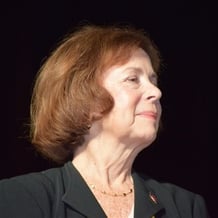 Rev. Kathi Austin Mahle (also a 1978 alum) has served on United’s board and on the Collegeville Institute board. “United,” she explains, “has this focus on ecumenical education, which then also reflects the ecumenical nature of Collegeville Institute. We’re all working toward a changed world and greater understanding that comes through education and providing scholars with the opportunity to explore their work in an ecumenical environment.”
Rev. Dr. A. Leon (Lee) Tredwell (’06) Honored As a 2026 Distinguished Alum
United Theological Seminary of the Twin Cities is excited to announce that Rev. A. Leon (Lee) Tredwell, PhD—who earned his MA in Theology and Biblical Interpretation from United in 2006—has been selected as a 2026 Distinguished Alum. An accomplished preacher, teacher, and published author, Dr. Tredwell has championed biblical narratives that affirm the divinity of all people, regardless of their race, creed, color, class, gender, or sexuality. Adopted at age four, Lee was raised in the Baptist faith and felt called to ministry as a child. Even so, after earning a degree in Political Science and Sociology at Concordia College in Moorhead, Minnesota, he spent the first ten years of his professional life as a grain trader for Cargill. After connecting with Drs. Ralph and Alika Galloway, Lee found United, and his call was reignited. He remembers Rev. Dr. Carolyn Pressler (Professor Emerita of Biblical Interpretation, 1990–2020) and Dean Richard Weis* with great affection. Both teachers, he observes, “taught us to wrestle with the biblical text until it opened up and spoke.” They also introduced Lee to Black and post-colonial hermeneutics, and Rev. Dr. Weis led him to passages in Jeremiah 38 (Hebrew Bible) that sparked his interest in learning more about a Black character named Ebed-Melech. Lee also cites the influence of Rev. Dr. Christine Smith’s (Professor Emerita of Preaching 1992–2013) preaching courses on his life. In Colorado, at the University of Denver and Iliff School of Theology, Lee completed a joint PhD program with a concentration in Religion and Social Change in 2017. Ronald Smith, a former United student who nominated Lee for this award, notes, “Dr. Tredwell has demonstrated that he is an innovator and compassionate leader who has served both inside the academy as a professor of African American Preaching at Iliff School of Theology, University of Colorado, Boulder, and in the larger community; he has served as [a] pastor, civil rights and human rights activist, and [a] chief executive officer in Colorado, Florida, Maryland, Minnesota, and Texas.” Lee’s new book—Black, Queer and Blessed: My Story and the Biblical Story Churches Don’t Teach—was published in June 2025. As the description reads, “For all who believe God-Yahweh is angry, mad, disgusted, and against LGBTQIA+ folx, regrettably, you been had, misled, took, hood-winked and bamboozled! Black, Queer and Blessed, through lived experience and the excavation of the subjugated biblical narrative of Ebed-Melech, demolishes society’s antiquated mores.” The book is part memoir and part theological reflection on the Ebed-Melech revelation. In addition to his roles as teacher, preacher, and author, Lee has specifically worked to promote adoption of Black children from foster care and create affordable housing. These days, he serves as the pastor of Theology and Community Engagement at Allendale United Methodist Church in St. Petersburg, Florida. As Ronald Smith asserts, “Dr. Tredwell is the embodiment and an exemplar of United Theological Seminary’s mission, vision, and values.” * of blessed memory About United Founded by the United Church of Christ (UCC) as a welcoming, ecumenical school that embraces all denominations and faith traditions, United Theological Seminary of the Twin Cities has been on the creative edge of progressive theological thought and leadership since it was established in 1962. Today, United continues to educate leaders who, through the eyes of faith, engage in the dismantling of systems of oppression, explore multi-faith spirituality, and push the boundaries of knowledge.