Bridgette Weber Finds the through Lines—Food and Transformation—at United

Academics Activism students

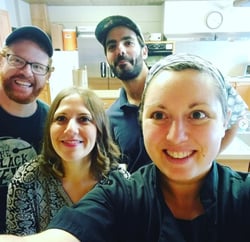
Breakfast time crop 2At United, a supportive community of beloved students and faculty, is an integral part of the educational journey for future faith and justice leaders. Since coming to seminary and charting a path toward chaplaincy, dual degree student Bridgette Weber (bottom right) has not only been elected to the Student Leadership Collective twice, they have also worked with another student to support and sustain United students with Sunday evening United Family Dinners. United has also helped them uncover their purpose-filled throughlines from food to social transformation to justice through food sovereignty. 

The connection between food and church is not anything new. Church potlucks, coffee and sweets between services, and pizza nights for youth groups are a familiar part of the landscape. As a seminary student, Bridgette is digging deeper to explore the broad historical import of food in culture, and how that connects to theological study. They are also developing a fundamental awareness of how issues of environment and justice and religion all intersect with the natural resources that sustain or degrade all life.

Working toward United & Social Justice Ministry

Bridgette’s connection to food started early. Their first job, at age 14, was at Taco Bell. Next, at Chilton, Wisconsin’s 7 Angels Restaurant, Bridgette worked with their mom and sisters and had their first experience working in the back of the house.

chef 3After growing up in a small Wisconsin town and attending rural Catholic churches, Bridgette was eager to see what their future might hold. They started college at the University of Wisconsin-Oshkosh, continued working in restaurants, dropped out of college, returned, and ultimately earned a bachelor’s degree in Environmental Studies. During college, Bridgette also found their “passion for building vibrant communities with food at the center.”

While studying biology and ecology, Bridgette worked in the community. They were a farmer and chef, managed Trust Local Foods (as the only employee), joined the Sustainable Living Roadshow as a green market manager, and founded the Oshkosh Food Cooperative which finally opened in July 2020.

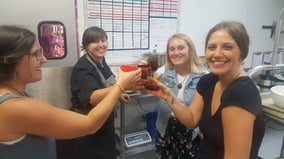
csa delightAfter college, they were a pastry chef at L’etoile Restaurant—a James Beard award winning farm-to-table establishment in Madison—and worked at Sarvodaya Shramadana Movement, a grassroots social transformation effort based in Sri Lanka. Bridgette was also a volunteer coordinator for a free clothing center and worked in “crisis management for houseless people.”
All the while, between rejecting the toxic aspects of the restaurant industry, starting their own personal chef business, and searching for purpose, the idea of a vital ministry around food and sustainability as represented by the image of a “food church” kept arising in their mind. “Those two words,” Bridgette explains, “are an anchor to my spiritual calling.”

Why? “Not only do I see food as a sacred intersection between our relationship to the land, water, and each other, but I see how this message of reality was subverted through colonization…and ways the Christian church codified slavery and industrial agriculture. I am drawn to work that moves us toward a dominant culture more in line with the Indigenous worldview of how to grow and manage food.”

When they found United online and discovered the seminary offered programming in Social Transformation, “there was no doubt” they state, “that it was a huge, cosmic, universal, divine YES happening inside of me.” And it was not just the possibility of ministering through food, but a distinctive call to social justice.

Finding Purpose at United & The Path Forward

United, as Bridgette explains, “is a place where I can explore the multitude of who I am.” The seminary enables them to “examine and explore the roots of where I came from—the complex and dynamic and beautiful and traumatizing space that is—while supporting me in an inclusive, welcoming, and affirming place.”

“Those accepting and nurturing aspects of United felt like a gift,” they add.

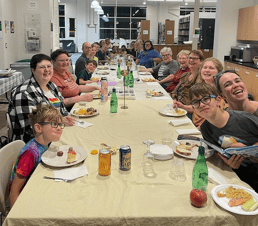
United Family Dinner croppedThe weekly United Family dinners provide an intentional and safe space for students and their families—and even regular guest President Molly T. Marshall (in a gray tee shirt on the right)—to share in good food and to nurture relationships. The meals are also a centering time to reflect on the values many students hold dear: creation care and sustainability for the planet.
“Right now,” they say, “it’s a sacred place for us to experiment with how food brings us into conversation with the land and our history.” What has been developing from the food church idea, they say, is a “food sovereignty ethic for the beloved community.” This ethic “is the right of peoples to healthy and culturally appropriate food produced through ecologically sound and sustainable methods, and their right to define their own food and agriculture systems.”1

The concept of the food sovereignty ethic, Bridgette suggests, could be a “powerful ethical antidote” for the practice of Christianity long shaped by “dominion theology.”

In simpler terms, Brigette adds, “I think food sovereignty has the power to heal many of our divides if we can invest our time, energy, and money into making it happen. I hope to see the church become a critical player in that transformation. As Dr. Norman Wirzba says, ‘Food is God’s love made nutritious and delicious.’ I think social transformation can be nutritious, delicious, and exciting!”

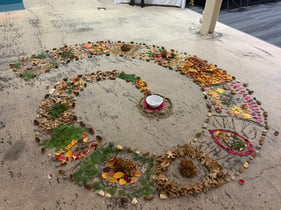
Bridgettes Mandala from 2021 Art ShowUnited’s focus on art and theology has also allowed Bridgette to express other facets of their artistic side. First introduced to community earth mandalas during her time with Sustainable Living Roadshow, Bridgette created a mandala for the 2021 Symposium Week. They have also used their drawing skills in class assignments, including an art observation of the St. Paul Farmers Market, and an examination of the trinity using artistically rendered sourdough starter, dough, and bread.

Through art, justice, and theology classes, Bridgette has also discovered how gender and sexuality are deeply connected to food. The 2022 summer term, they add, “brought together the articulation and minds of amazing writers and activists and humans who have been forging this path” of actively promoting justice. “That’s the kind of person I want to be.”

The painstaking process of “getting to know deeply who I am,” though challenging, has also enabled Bridgette to lay bare their roots and start to reconcile the past with their goals for the future. The through lines of food and justice make possible the plan to bring the leadership and ministry skills they have gained at United back to the rural areas they left years ago.

“I want unity and connection, and know that building these types of relationships will take care and time and attention. Joy and creative potential are just waiting for us,” Bridgette declares.


1. This is the definition of food sovereignty coined by La Via Campesina in 1996.

Explore More Articles

Rev. Dr. A. Leon (Lee) Tredwell (’06) Honored As a 2026 Distinguished Alum

United Theological Seminary of the Twin Cities is excited to announce that Rev. A. Leon (Lee) Tredwell, PhD—who earned his MA in Theology and Biblical Interpretation from United in 2006—has been selected as a 2026 Distinguished Alum. An accomplished preacher, teacher, and published author, Dr. Tredwell has championed biblical narratives that affirm the divinity of all people, regardless of their race, creed, color, class, gender, or sexuality.  Adopted at age four, Lee was raised in the Baptist faith and felt called to ministry as a child. Even so, after earning a degree in Political Science and Sociology at Concordia College in Moorhead, Minnesota, he spent the first ten years of his professional life as a grain trader for Cargill. After connecting with Drs. Ralph and Alika Galloway, Lee found United, and his call was reignited. He remembers Rev. Dr. Carolyn Pressler (Professor Emerita of Biblical Interpretation, 1990–2020) and Dean Richard Weis* with great affection. Both teachers, he observes, “taught us to wrestle with the biblical text until it opened up and spoke.” They also introduced Lee to Black and post-colonial hermeneutics, and Rev. Dr. Weis led him to passages in Jeremiah 38 (Hebrew Bible) that sparked his interest in learning more about a Black character named Ebed-Melech. Lee also cites the influence of Rev. Dr. Christine Smith’s (Professor Emerita of Preaching 1992–2013) preaching courses on his life. In Colorado, at the University of Denver and Iliff School of Theology, Lee completed a joint PhD program with a concentration in Religion and Social Change in 2017. Ronald Smith, a former United student who nominated Lee for this award, notes, “Dr. Tredwell has demonstrated that he is an innovator and compassionate leader who has served both inside the academy as a professor of African American Preaching at Iliff School of Theology, University of Colorado, Boulder, and in the larger community; he has served as [a] pastor, civil rights and human rights activist, and [a] chief executive officer in Colorado, Florida, Maryland, Minnesota, and Texas.” Lee’s new book—Black, Queer and Blessed: My Story and the Biblical Story Churches Don’t Teach—was published in June 2025. As the description reads, “For all who believe God-Yahweh is angry, mad, disgusted, and against LGBTQIA+ folx, regrettably, you been had, misled, took, hood-winked and bamboozled! Black, Queer and Blessed, through lived experience and the excavation of the subjugated biblical narrative of Ebed-Melech, demolishes society’s antiquated mores.” The book is part memoir and part theological reflection on the Ebed-Melech revelation.  In addition to his roles as teacher, preacher, and author, Lee has specifically worked to promote adoption of Black children from foster care and create affordable housing. These days, he serves as the pastor of Theology and Community Engagement at Allendale United Methodist Church in St. Petersburg, Florida. As Ronald Smith asserts, “Dr. Tredwell is the embodiment and an exemplar of United Theological Seminary’s mission, vision, and values.” * of blessed memory About United Founded by the United Church of Christ (UCC) as a welcoming, ecumenical school that embraces all denominations and faith traditions, United Theological Seminary of the Twin Cities has been on the creative edge of progressive theological thought and leadership since it was established in 1962. Today, United continues to educate leaders who, through the eyes of faith, engage in the dismantling of systems of oppression, explore multi-faith spirituality, and push the boundaries of knowledge.

Lena K. Gardner (’15) Honored As a 2026 Distinguished Alum

[caption id="attachment_11955" align="alignnone" width="1920"] photo by Bethany Birnie[/caption] United Theological Seminary of the Twin Cities is thrilled to announce that Lena K. Gardner—who graduated with an MA in Justice and Peace Studies in 2015—has been selected as one of our three 2026 Distinguished Alums. A highly respected social justice activist and community leader, Lena is the co-founder and executive director of Black Lives of Unitarian Universalism (BLUU), a nonprofit founded in 2015 that creates life-giving and life-saving opportunities for spiritual community and Black-centered organizing.   According to Rev. Dr. Rebecca Voelkel (’13), Lena has “been a force in the Twin Cities’ religiously rooted justice ecosystem for the last 15 years.” Dr. Voelkel, Lena’s nominator, traces Lena’s justice-organizing acumen back to 2011, when she served on the Faith Organizing Roundtable—a body that coordinated religious communities’ opposition to the anti-marriage amendment. Lena went on to champion marriage equality in the 2012–2013 legislative session. After a white police officer in Ferguson, Missouri, shot and killed Michael Brown, Jr., an unarmed 18-year-old Black teen, in 2014, Lena played a key role in transforming the Faith Organizing Roundtable into the Multifaith Anti-Racism, Change & Healing or MARCH. “In that same period,” Voelkel notes, “Lena was a core team organizer of Black Lives Matter Minneapolis and served on its steering committee.” Lena was deeply involved, quoted in many national and local articles, and interviewed on Minnesota Public Radio after former police officer Derek Chauvin killed George Floyd in 2020. In April 2021, after a Brooklyn Center police officer killed Daunte Wright during a traffic stop, Lena co-wrote an article in the Sahan Journal demanding that Attorney General Keith Ellison prosecute the case, and that the Hennepin County attorney be removed. More recently, Lena embarked on another ambitious project. In May 2024, through the BLUU Cooperative Housing Initiative, she co-hosted a groundbreaking ceremony for an affordable housing complex for single parents in North Minneapolis. In a MinnPost article about the groundbreaking, Lena explained, “It’s really about trying to give back to one of the communities that made me…. We really see providing stable housing in a cooperative framework as one of the many paths to collective liberation and Black liberation. Ultimately, it’s about self-determination.”  When Operation Metro Surge arrived in the Twin Cities in late 2025, Lena took action again. As Voelkel observes, she “returned to the MARCH steering committee…. When MARCH organized a clergy call (in five days) to which 700 clergy came, the ability to create and host such an amazing event owes part of its success to Lena’s relationships with communications specialists, graphic designers, and organizers.” Lena was also a driving force behind Neighbors Helping Neighbors (NHN), a mutual aid group she and Anna Stamborski founded in late 2025 to connect vulnerable ICE-targeted families with congregational networks whose members could provide shopping and transportation services.  Through all of Lena’s indefatigable contributions to working for justice, Voelkel asserts, she “has focused on Black excellence, Black power, Black spiritual wholeness, Black beauty, and how non-Black folks can act in solidarity and followership of Black folks, particularly Black queer women. She has done so skillfully through building relationships across differences in ways that facilitate and deepen genuine relationships.”

Cori Berg (’98) Honored As a 2026 Distinguished Alum

United Theological Seminary of the Twin Cities is elated to announce that Cori Berg (’98)—advocate, artist, and educator—is a 2026 Distinguished Alum. Cori earned her Master of Arts (MA) in Theology and the Arts in 1998, and for more than 27 years, she has integrated creativity, art, and spirituality into her field. Cori arrived at United in the 1990s, having majored in theater and minored in studio art during her undergraduate studies. “I knew I had an artistic voice,” she recalls, “but it didn’t make sense in any of the traditional contexts.” After seeing an advertisement for United’s Theology and the Arts program, Cori drove from Dallas to the Twin Cities to visit as a prospective student. A campus art exhibit by Merle Janis was all she needed to see—“this school had something I needed: strength, boldness, vulnerability.” For Cori, “life is liturgy.” She credits United with introducing her to “the freedom in a progressive faith.” At United, Cori learned to expand her creativity, which became a launching pad for a vibrant career. “United gave me a safe, nurturing space to explore, dream, and execute big things,” she writes. “I’ve continued that through the rest of my career as an artist, an educator, an administrator, and a speaker.” Art is central to Cori’s work and features prominently in her curriculum development for children. Her art was featured in the 2012 opening parade for the Margaret Hunt Hill Bridge in Dallas, TX, a project that involved “seniors, children, and adults in all aspects” from a local Methodist community program. Ministry with Children and Spirituality, courses taught by Rev. Dr. Barbara Anne Keely (Professor Emerita, 1991–2015), were particularly formative for Cori’s future in education. “I remember she taught us to get on the floor and view the church nursery from a baby’s point of view,” Cori reflects. “I use this today over and over as I teach early childhood educators…. She introduced the idea of seeing oneself not as a separate body, mind, or spirit, but when one part of my being is suffering, to use the other parts to help lift that part.” More recently, Cori has been an active community member at Dallas Meditation Center, where she is known for her moving dharma talks that weave Buddhist themes into contemporary storytelling. In public schools and congregational settings, Cori has applied what she learned as a United student to the field of early childhood education, for which—nominator Rev. Jim Peck (’99) points out—she has become “one of the nation’s leading advocates.” When facing challenges in the throes of the COVID-19 pandemic, Cori leveraged her ingenuity and creative vision to support educators with online training resources. As a teacher and an administrator in spaces where lack of institutional funding and support are commonplace, Jim observes, “she uses her [United] education to work for justice and equity,” to “nurture relationships in the early childhood settings where she has served, with an expertise in working in settings in crisis to encourage recovery, healing, and new paths for serving the future.” In May 2026, Cori completed her MEd in Curriculum and Instruction at American College of Education, where she immediately enrolled to begin her EdD in Early Childhood Education. She serves as an executive director at the University of Kansas (KU) and anticipates returning to Dallas to live near her family at the end of the year while awaiting her next opportunity. We are delighted to celebrate Cori and her decades of faithful, innovative leadership in the field of early childhood education and art. About United Founded by the United Church of Christ (UCC) as a welcoming, ecumenical school that embraces all denominations and faith traditions, United Theological Seminary of the Twin Cities has been on the creative edge of progressive theological thought and leadership since it was established in 1962. Today, United continues to educate leaders who, through the eyes of faith, engage in the dismantling of systems of oppression, explore multi-faith spirituality, and push the boundaries of knowledge.