At United, Kateri Boucher Is Inspired to Chase Her Childhood Dreams

Activism Community Relationships Distance Education VOICES

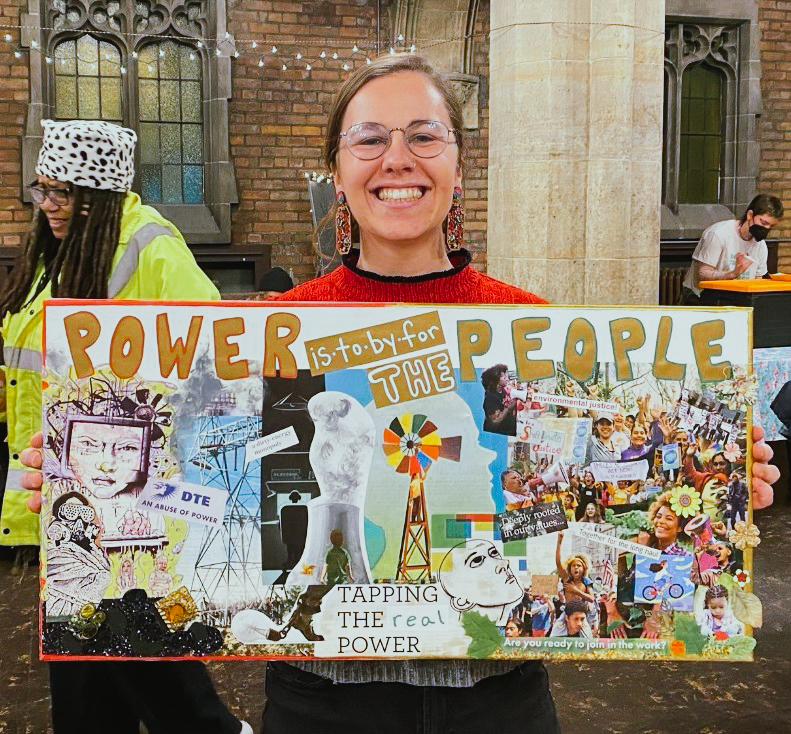
Kateri BoucherKateri Boucher, who is pursuing an MDiv in Church Leadership, felt a call to ministry very early. “I was three when I told my mom I wanted to be a priest,” she recalls. She adds, “I would preach homilies and make [my mom] write them down.” Raised in Upstate New York, Kateri’s family attended a progressive Catholic church untethered from Roman Catholic strictures. Watching a woman priest serve communion sparked her pronouncement.

Years later, after attending a liberal arts college, Kateri jumped at a chance to work on an “urban agriculture” project in Detroit. The community she found through the Catholic Worker and an Episcopal church rekindled her sense of calling, so she moved there. Now, at United, Kateri is making her dreams a reality.

Searching for a Seminary

About four years ago, Kateri began searching for a seminary. She researched a few schools, but realized she didn’t want to leave Detroit. She had just been hired at St. Peter’s Episcopal Church and hoped to continue that work. Sarah Holst (’20) recommended United.

The more she learned about United, the more it seemed like the best choice. “I wouldn’t have to sacrifice what I [wanted] to do an online program,” she remembers thinking, “and it would allow me to stay rooted in Detroit and…work at St. Peter’s.” 

Transformational Teachers

During her first semester at United, Kateri took two classes with Rev. Dr. Andrew Packman, assistant professor of Theological Ethics and Formation. Class assignments and interactions, Kateri notes, really opened her mind to ways in which theology has evolved. “It is such a gift,” she declares, “to get to study with someone for whom teaching is so clearly a vocational call. I’ve rarely interacted with someone who has such a sharp mind and such a generous spirit.”

Dr. Jennifer Maidrand—visiting assistant professor of Bible, Culture, and Interpretation, supported by the Louisville Institute—taught courses that Kateri took recently. A guest poet in the Hebrew Bible class was a “really cool” highlight. And, in the Bible and Palestine-Israel class, Kateri asserts that Dr. Maidraid “led us so gracefully through really challenging conversations throughout the semester [and] basically every…assignment for this class is something applicable to the real world.”

Rev. Dr. DeWayne Davis, Kateri’s preaching professor, created another memorable experience. “His passion [for preaching],” she quips, “was palpable from miles away over a Zoom screen! He really brought it to life and held us in a beautiful way.” Through the class, Kateri notes that she learned strategies for telling “compelling stories.” She can use that at St. Peter’s, when she preaches each month.

Distance Learning

Because she wanted to balance her part-time work at St. Peter’s, service projects, and seminary, Kateri sincerely appreciates United’s distance learning program. “I remember telling people in my first semester that it’s clear that this school didn’t just start doing online classes during COVID;” they’ve had years “honing the art of hybrid classes.”

She’s also made a lot of seminary friends. It’s so easy, Kateri shares, to message someone and say, “Hey, do you want to connect out of class?” The chat feature in Zoom also makes the in-class learning process more interactive.

Formulating a Future

Kateri describes another support from United, the Dayton Scholarship, as a “total blessing and game changer.” The funding, she reveals, “has enabled me to keep working … at St. Peter’s and participate in the church’s service outreach programs.” She’s hoping to add a second MA, made possible by the scholarship.

As she looks ahead, Kateri knows changes will come. She’s started ordination and will leave St. Peter’s for a new call. In the United community, she sees “a real beauty, that we are scattered like seeds around the country and the world,” asking key questions. Still, she admits, “it was nourishing to come to United for Symposium Week; it “helped me to feel more rooted in the community.” In sum, Kateri exclaims, “I just love United so much! I’m so grateful it exists.”

Explore More Articles

Rev. Dr. Tim McGregor (’26) Finds Hope for Healing in Exploratory Theology

Rev. Dr. Tim McGregor (’26) has been a chaplain, pastor, and church planter for years. How did he find this well-trodden path? Tim says his mother introduced him to Christ. “She was very devout,” he explains. Unfortunately, she was also very sick, so Tim spent more time in hospitals than in church as a child. Still, he recalls one incident during communion when he was 11. Tim shares that he “had a very out-of-body experience with the divine while I was in church, and it touched my soul.”  Tim grew up and pursued a BA at Tuskegee University. While there, he experienced another out-of-body experience when he was robbed at gunpoint and stabbed. “At that point,” he reflects, “I decided to rethink some of my living and some of my decisions. It reignited my spiritual walk.”  As he changed the way he lived, Tim felt a spiritual nudge. Others observed that they “saw the calling” on his life. And dreams about preaching began to recur. “Before I ever preached a sermon, I dreamed I was preaching…in the same church where I ended up preaching later on.”   Christian Theological Seminary Though Tim identified as National Baptist, he decided to attend Christian Theological Seminary (CTS) in Indiana—a progressive school aligned with the Christian Church (Disciples of Christ). It helped that Dr. Edward Wheeler, an ordained Baptist minister whom Tim knew when Wheeler worked at Tuskegee, was CTS’s president. During a United chapel service this March, Tim described his experience at CTS as “quite grueling,” but also that he “learned a lot.” As he clarified more recently, he had to “let go of a very fundamentalist perspective,” and that sort of deconstruction was difficult. “It was a crucible situation,” Tim asserts.    Chaplaining and Church Planting After earning his MDiv in 2003, Tim spent years in Mississippi and Texas planting churches and working as a hospital chaplain. Since returning to Minnesota, he’s been a chaplain at Regions Hospital, Abbott Northwestern, and the Minneapolis VA Medical Center, and pastored at Family Bible Church. He suspects that the time he spent with his mother in hospitals likely inclined him toward hospital chaplaincy.  When he decided to pursue a DMin, Tim reviewed his options. Only United, he found, had the interreligious chaplaincy program and liberal ethos that made his MDiv work transformational. Plus, he could attend onsite or online as his schedule allowed. “It was a great benefit,” Tim attests, “to do both.”   United and Nat Turner  Tim credits Dr. Jessica Chapman Lape, former director of the Interreligious Chaplaincy program, with positively shaping his education. Her theological knowledge and emphasis on her African American heritage impressed him. Dr. Munjed Murad’s Comparative Theology course elevated Tim’s intercultural acuity. Munjed is an assistant professor of World Religions and Intercultural Studies, supported by the Johnson-Fry Endowment.  Tim describes his dissertation, “The Exploratory Theology of Nat Turner and Its Effects on African and African American PTSD,” as “a labor of love.” Why Nat Turner? “I appreciate his passion and his desire to live and fight for the rights of his people,” Tim explains, “and his willingness to do so in the name of his religious beliefs.” In addition, “I’m always interested in people that…have been misunderstood or written off as villains.”  Shepherded with vital support from Rev. Dr. Andrew Packman (assistant professor of Theological Ethics and Formation), Tim’s dissertation studies Nat Turner, his traumatic experiences as a slave, and his burgeoning theology. It also traces links to the moral injury, trauma, and PTSD endemic to military service, especially for African American veterans.  Tim wants to “understand more about…how to be an asset to my community.” He feels that “United was a really good place for that” and is a rich resource for “clergy…and spiritual caregivers” who are going to help us “keep pressing toward better understandings.” Tim is grateful for United’s role in honing his academic and spiritual voice.

Rev. Dr. Justin Sabia-Tanis to Be Appointed Inaugural Occupant of the Wilson Yates Chair in Theology and the Arts

Saint Paul, Minnesota, United States, June 5, 2026 — United Theological Seminary of the Twin Cities is elated to announce that Rev. Dr. Justin Sabia-Tanis will be appointed as the first-ever occupant of the Wilson Yates Chair in Theology and the Arts. Until now, he has served faithfully as the McVay Associate Professor of Christian Ethics and Social Transformation, as well as Director of the Social Transformation Program. Before joining United, Rev. Dr. Sabia-Tanis served as a congregational minister in Boston, Honolulu, and San Francisco, and was Director of Leadership Development for Metropolitan Community Churches, after which he joined the United Church of Christ (UCC). Rev. Dr. Sabia-Tanis’ ministry includes community organizing and advocacy. He has served as managing director at the Center for LGBTQ and Gender Studies in Religion (CLGS) as well as communications director for the Hawai’i Equal Rights Marriage Project, the National Center for Transgender Equality, and Out & Equal Workplace Advocates. He received his PhD in Interdisciplinary Studies from Graduate Theological Union in 2017, his DMin from San Francisco Theological Seminary in 2003, and his MDiv from Harvard Divinity School in 1990. His teaching experience spans courses at the University of Arizona, Pima Community College, Iliff School of Theology, and Pacific School of Religion. As an eminent academic and theologian, Dr. Sabia-Tanis’ scholarship has deepened the study of the intersection of art and LGBTQ+ religious identity. He recently completed writing Queer Spirituality, Sexual Orientation, and Gender Identity in Contemporary Visual Art, to be released later this year by Bloomsbury Academic. Dr. Sabia-Tanis also wrote the groundbreaking book Transgendered Ministry, Theology and Communities of Faith (Cleveland: Pilgrim Press, 2003; Wipf & Stock, 2018) and authored a chapter in Transbiblical: New Approaches to Interpretation and Embodiment in Scripture (Louisville, KY: Westminster John Knox Press, 2025).  In 2024, he gave a lecture in the art gallery of Hennepin Avenue United Methodist Church in Minneapolis, MN, on the life and art of Keith Haring. Dr. Sabia-Tanis is himself an artist, and he hones and cultivates the creative expression of the artist-theologians enrolled in his courses. In his announcement of the news to United students, Dr. Kyle Roberts—Dean and Vice President for Academic Affairs—connected Rev. Dr. Sabia-Tanis’ education and qualifications to the field of theology and the arts. “Dr. Sabia-Tanis appreciates and champions the legacy of Dr. Yates and the leadership of United in the area of arts and theology,” Dr. Roberts asserted. “He also advocates for the intersection of the arts with movements for social justice and will bring to his teaching and leadership a synergy of theology and arts, along with his contributions to the education of social transformation at United.” Rev. Dr. Molly T. Marshall, President, commended the news for this esteemed member of the faculty. “The wide-ranging scholarship of Dr. Justin Sabia-Tanis will elevate this position as the arts serve as a medium for social transformation.” Established in 2025 by generous gifts from friends, alums, and former United faculty, the Wilson Yates Chair in Theology and the Arts is an endowed faculty position named after Rev. Dr. Wilson Yates, President Emeritus and Distinguished Professor Emeritus of Religion, Society, and the Arts. Yates joined United’s faculty in 1967, became Dean in 1988, and was made President in 1996. He retired from the seminary in 2005, having led and innovated in theology and the arts, deepened scholarship, and integrated the subject as a pillar of United’s academic programs. Rev. Dr. Yates celebrated the news and is eager to see Rev. Dr. Sabia-Tanis installed into the chair. He reflects, “I am very excited about Justin’s selection for this role. His studies at the Graduate Theological Union in Berkeley will provide an important background to this work. Justin brings a solid understanding of the relationship to the arts in theology, the church, and everyday life. It is not incidental that he is also a practicing artist.” On his appointment to the chair, Rev. Dr. Sabia-Tanis shares, “United has valued and integrated the arts since our founding. They are critical to how our students are formed, and in the ministries and projects they will lead when they graduate. I am so honored to move into this important role at United and continue the incredible legacy of Wilson Yates. And I'm looking forward to the ways this program will evolve and grow in the coming years.” The installation of Dr. Sabia-Tanis into the Wilson Yates Chair in Theology and the Arts will be formally celebrated at Fall Convocation on Thursday, September 24, 2026. Details will be announced in the coming months. About United Founded by the United Church of Christ (UCC) as a welcoming, ecumenical school that embraces all denominations and faith traditions, United Theological Seminary of the Twin Cities has been on the creative edge of progressive theological thought and leadership since it was established in 1962. Today, United continues to educate leaders who, through the eyes of faith, engage in the dismantling of systems of oppression, exploring multi-faith spirituality, and pushing the boundaries of knowledge. Contact Nathanial Green (he/him) Director of Marketing and Communications press@unitedseminary.edu • 651.255.6138 Admissions and Enrollment admissions@unitedseminary.edu

The Barnabas Society: Transformative Legacies Lead to Transformed Lives

Since its inception in 1962, United has been sustained by faithful supporters who believe in transformative theological education. This support—from one-time gifts, to recurring contributions, to stock designations—makes the seminary’s work possible. One group of dedicated donors, members of United’s Barnabas Society, views their commitment to progressive seminary education as extending for a lifetime and beyond. The Barnabas Society recognizes those who have included United in their estate plans. This group of donors is named after Barnabas, an apostle introduced in Acts 14, who provided financial support to his fellow apostles with proceeds from the sale of his land. These gifts typically reflect donors’ values— principles that are aligned with the seminary’s mission, vision, and values. Legacy gifts ensure these precepts are practiced in the classroom and realized beyond the institution’s walls. Gifts can include income-return gifts and beneficiary designations—financial support that expresses the donor’s philanthropic intent while providing long-term stability for United’s mission—and the legacies of their generosity live on in endowed scholarships, faculty chairs, lectureships, and seminary programming.  Now in its 35th year, the Susan Draper White Lecture is a beloved annual event that draws leading feminist theologians to the seminary. It was named after the grandmother of United alum Rev. Cil (Priscilla) Braun† (’83), who, with other donors, endowed the lectureship series. Cil and her husband, Jack, the Barnabas Society through a legacy gift that helped support the newly established Wilson Yates Chair in Theology and the Arts. Cil’s legacy has spanned decades, and her generosity has informed, inspired, and continued to support United students. In 2021, United celebrated the creation of a tenure-track faculty position. Rev. Dr. Andrea Johnson (’17, ’23) and David Fry committed $1.75 million to endow the Johnson-Fry Chair in World Religions and Intercultural Studies, held by Dr. Munjed M. Murad. As an ordained Unitarian Universalist minister, Andrea sought to strengthen the seminary’s commitment to Interreligious Engagement, saying, “While we are grounded in our Christian heritage, more and more we are educating leaders in religions other than Christianity. And we need all our religious leaders to be deeply responsive to the realities of religious and spiritual diversity.”  An alum and trustee, Andrea knows how United impacts its students and their communities, sharing, “I was transformed by the education I received at United, and [I] am passionate about supporting its future.”  At Fall Convocation in September 2024, Dr. Demian Wheeler, director of Advanced Studies, was formally installed into the newly endowed Sophia Chair in Religious and Theological Studies. Former trustees Keith Bednarowski and Dr. Mary Farrell Bednarowski, Professor Emerita of Religious Studies (1976–2004), who funded the Chair, have been part of the United community for nearly 50 years. In an interview for the Winter 2024 Issue of VOICES, Mary reaffirmed her commitment to United, saying, “I have a very deep faith that this full-of-life seminary will persist and flourish for many, many years. Keith and I want to be part of that flourishing.” The Barnabas Society is growing. In 2026, trustee Therese Pautz and her husband, David Graham, committed to a legacy gift. Reflecting on their decision, she writes, “We support United because it equips spiritual leaders and community healers.” She continues, “Those vocations are essential to every civil society, especially in times of conflict.” Therese and David will be formally welcomed into the Barnabas Society later this year.  These are just a few shining examples of the cadre of faithful supporters who have made legacy gifts and transformative commitments. Their support for the sustained life of the seminary reflects their values and belief in the importance of United’s mission in our ever-evolving world.  To discuss a legacy plan, contact Rev. Dr. Cindi Beth Johnson, Vice President for Advancement, by email at cbjohnson@unitedseminary.edu or by phone at 651.255.6137.