




Stations of the Cross

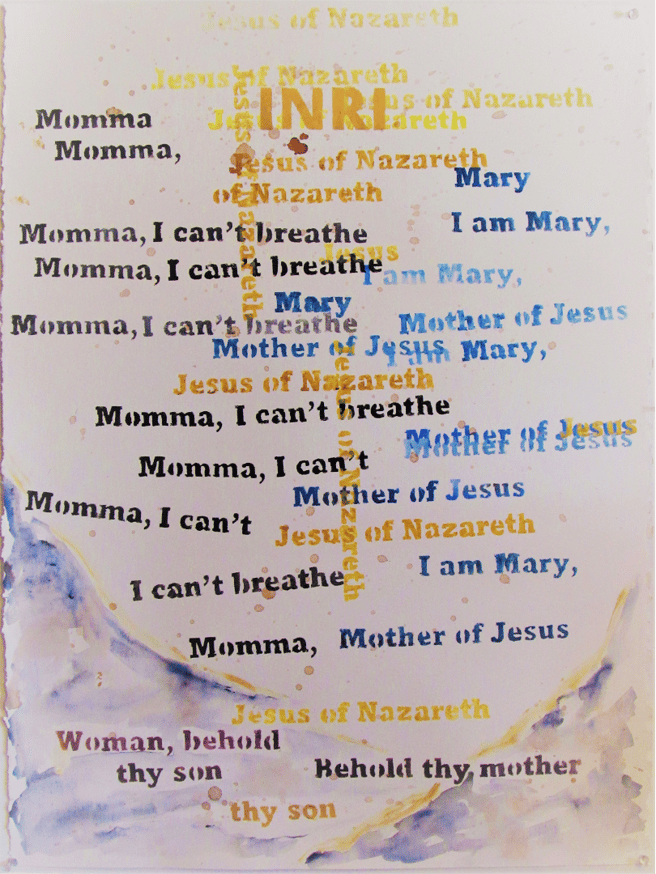
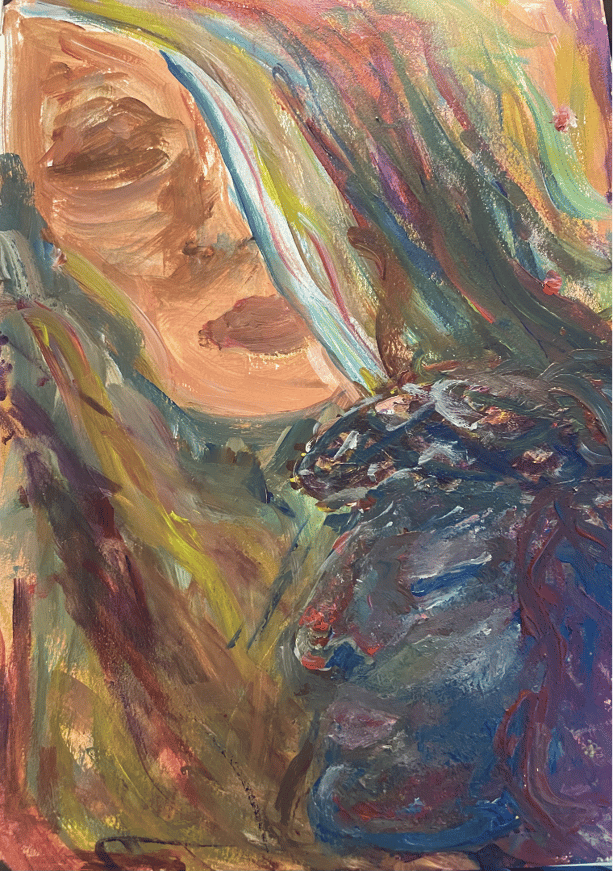
The Stations of the Cross has its origins in the early Christian practice of visiting the sites of Jesus’ passion in Jerusalem. Over the centuries, it has since developed into a kind of mini- or local pilgrimage in which the faithful process through the fourteen stations, often represented by plaques or artwork within a church building. In a time of pandemic, we invite you to join us on an imaginative pilgrimage through the following artists’ images, poems, and reflections. 

  1. Jesus is condemned to death.

By Dustin Wilsor

  1. Jesus carries his cross.

By Dee Grover

  1. Jesus Falls for the first time.

By Andrea Roselle

  1. Jesus meets his mother Mary.

By Elizabeth Jacobson

  1. Simon of Cyrene helps Jesus carry the cross.

By Justin Sabia-Tanis

  1. Veronica wipes the face of Jesus.

By Alaina Hoffman

  1. Jesus falls the second time

By Jennifer Awes Freeman


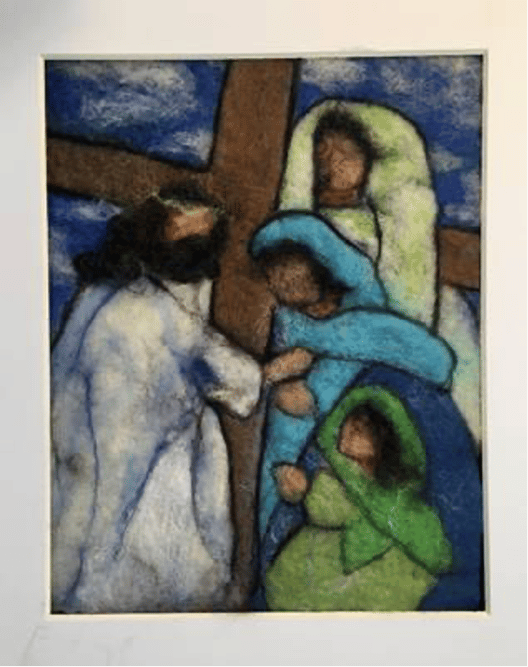
  1. Jesus meets the women of Jerusalem

By Melissa Miller

Jesus spent much of his earthly life comforting, healing, uplifting, protecting, and empowering women. Here, women lean in to offer their consoling embrace to him. They represent the women of the world weeping for justice and mercy, while teaching us the beauty of compassion that flows through our wordless tears. Yet even in his final hour, Jesus stops to comfort the sad; a simple act of grace to calm them as he foretells the destruction to come. 

 “Do not weep for me, but weep for yourselves and for your children.”

  1. Jesus falls for the third time

By Elizabeth O’Sullivan

  1. Jesus is stripped of his clothes.

By Max Yeshaye Brumberg-Kraus

Note: The original video is not included here due to nudity and sexual content.

In lieu of cutting out scenes or censoring images in the video, the artist has agreed to replace their submission with the following passage from the 19th Ecumenical Council held between 1545-1563: “Moreover, in the invocation of saints, the veneration of relics, and the sacred use of images, every superstition shall be removed, all filthy lucre be abolished; finally, all lasciviousness be avoided; in such wise that figures shall not be painted or adorned with a beauty exciting to lust […] In fine, let so great care and diligence be used herein by bishops, as that there be nothing seen that is disorderly, or that is unbecomingly or confusedly arranged, nothing that is profane, nothing indecorous, seeing that holiness becometh the house of God.”

Baring the Cross Artist Statement

Max Yeshaye Brumberg-Kraus

In Station 10, Jesus is stripped of his garments and the Roman soldiers divvy up his clothes. The Vatican links this station to the Edenic tragedy: “the expulsion from Paradise: God’s splendour has fallen away from man, who now stands naked and exposed, unclad and ashamed.”[1]

In Eden, the serpent tells Eve: “your eyes shall be open, and ye shall be as gods.”[2] Thus she eats the fruit. Is the serpent simply a liar, or is nakedness a revelation? Human’s first knowledge is knowledge of the nude self: “the eyes of them both were opened, and they knew that they were naked.” Look. Desire. Know: apotheosis. Sight becomes self-sight and sight of the other. Please me, and I will please you: see my nakedness, and we will be as gods.

If the gift of Jesus’s body to the world is also his revelation, how might the naked body in Paradise similarly be gift and revelation. What occurred between the opening of their eyes and the eventual shame? Did Eve and Adam experience a frightening, mutual self-objectification, a giving of oneself to the other, a move to queer subject-subject consciousness, a mutual relinquishing of self out of love for the other and in so doing approach divinity? But they ultimately withdraw from divinity. God walks in Eden, and the humans “hid themselves […] amongst the trees of the garden.” They do not give unto God, but hoard their flesh: “I was afraid […] I was naked; and I hid myself.”[3] Unable to relinquish themselves to one another, let alone to God, the humans revert to a hierarchical relationship, a heterosexuality ordained by a God who has seen his humans fail to be gods, failed to give as gods, generously, through their skin. God decrees Adam the doer, Eve the done, Adam the actor, Eve acted upon, subject and object. And if God was any good, perhaps God wept.

Christ, divine incarnation, arrives to undo this paradigm, the god/man enacting agency through his own objectification, giving unto others as they should give of themselves. But when the Romans bare Jesus, they still bear clothes upon their backs. They devour him not as living nourishment, but in a perverse Eucharist of Jesus’s possessions and Jesus as possession. Is this the origin of Christianity

With an added layer of interpretation through “The Twa Corbies,”[4] a Scots folk ballad in which two birds discuss an abandoned corpse they are about to eat and incorporate into their nest, the Romans are both compared to and contrasted with carrion eaters. For while magpies and crows are emblematic of natural life contingent on death, Rome and Christendom are emblematic of supernatural life contingent on killing.

Contrasting Christian colonization, dehumanization, and capital with the genderbent, stripper Christ, Baring the Cross asks how do we see our bodies and give our bodies, how are our bodies seen and taken, how might queer and trans people—the sexual and gender marginalized–know God’s body, and ultimately, what is most shameful: a body stripped or the stripping of the body?

[1] “Tenth Station,” https://www.vatican.va/news_services/liturgy/2005/via_crucis/en/station_10.html

[2] Gen 3:4, 3:7 KJV

[3] Gen 3:8, 3:10

[4] “Child Ballad 26: The Three Ravens/Twa Corbies,” in Bertrand Harris Bronsin and Francis James Child, The traditional tunes of the Child ballads: with their texts, according to the extant records of Great Britain and America (Princeton, N.J.: Princeton University Press, 1959).

Explore More Articles

United Celebrates Largest New Class and Highest Enrollment in Its 65-Year History

Enrollment Has More than Tripled in Ten Years For the second consecutive year, United Theological Seminary of the Twin Cities (United) is thrilled to welcome its largest-ever incoming class of degree-seeking students. With 85 new degree-seeking students, the seminary is celebrating a total fall term enrollment of 288 degree-seeking students and 7 certificate students, representing the largest total enrollment in United’s history. The seminary’s 65th academic year features: 25% year-over-year enrollment growth and a staggering 239% increase over fall 2016; 163 Master of Divinity (MDiv) students, an increase of 42% year-over-year; 63 Master of Arts (MA), Master of Arts in Leadership (MAL), and Master of Arts in Ministry (MAM) students; 62 Doctor of Ministry (DMin) students. Public theology, social transformation, interreligious engagement, and theology and the arts comprise the four foundational pillars of United’s curricula. They are unique among seminaries and divinity schools rooted in Christian traditions, cultivating an educational environment that practices ecumenism, religious pluralism, and social justice. The MDiv in Interreligious Chaplaincy is United’s largest degree program, with 73 students enrolled for the fall term. The concentration’s interfaith emphasis sets the school apart among its peers, drawing students from diverse backgrounds and faiths. Reflecting the program’s flagship status, the seminary marked a new milestone on July 1 when it welcomed Dr. Ginger Morgan as associate professor for Pastoral and Spiritual Care and program director for Interreligious Chaplaincy. United’s considerable ten-year growth can be credited to its leading-edge academic offerings, widely accessible distance education, and accomplished faculty. The seminary is a bold witness for the common good, preparing innovative leaders for myriad vocational and professional outcomes. From rural congregations to the city hospital’s ICU, United students and alums equip their communities for justice and peace. Mason Mennenga (’22), director of Admissions, leads a passionate and creative staff, all of whom are current students or alums. He reflects, “United’s growth in enrollment over the last number of years and our record for this year is truly a remarkable achievement in theological education. We’re showing what’s possible for progressive theological institutions!” Dr. Hillary Vamstad, director of Student Services, adds, “We’ve created an environment where students feel more than just a number, and I think students see that through the admissions and onboarding process. Feeling seen, heard, and supported while pursuing a seminary education is an important component to United’s growth.” Growth in student enrollment underscores the need to increase the number of core faculty members to continue to provide the quality of education for which United is well-known. Dr. Kyle Roberts, Vice President for Academic Affairs and Dean, shares, “We are undertaking two faculty searches this year, which include an additional faculty role focused on Ministry Practices. This is a specialty we have been needing for some time on our core faculty to ground students in the practical elements of ministry leadership, such as preaching and liturgy, religious education, institutional leadership and administration.” Rev. Dr. Molly T. Marshall, who is beginning her final year as United’s beloved president, asserts, “I believe United’s remarkable growth is due to our progressive and relevant curriculum, our theological hospitality, and our accessible educational delivery.” She continues, “We delight in creating space (perichoresis) for everyone who desires formative theological education, a distinctive pursuit among seminaries.” United looks ahead to a historic 65th year of progressive theological education, and we give thanks for the students whose vocations, traditions, and unique perspectives enrich the life of our seminary. About United Founded by the United Church of Christ (UCC) as a welcoming, ecumenical school that embraces all denominations and faith traditions, United Theological Seminary of the Twin Cities has been on the creative edge of progressive theological thought and leadership since it was established in 1962. Today, United continues to educate leaders who, through the eyes of faith, engage in the dismantling of systems of oppression, explore multi-faith spirituality, and push the boundaries of knowledge. Media Contact Nathanial Green (he/him) Director of Marketing and Communications press@unitedseminary.edu • 651.255.6138 Admissions and Enrollment admissions@unitedseminary.edu

United Launches National Search for Its Next President

The Position Profile and Application Are Now Available Today, the Presidential Search Committee, on behalf of United Theological Seminary of the Twin Cities, is opening the national search for the seminary’s next leader. This comes after the July announcement of Rev. Dr. Molly T. Marshall’s 2027 retirement following six transformative years of institutional growth and expansion. United’s next president will helm a dynamic school with a student body that has more than doubled in size in just ten years; a world-class faculty of artists, scholars, and theologians; and a diverse and interreligious student body preaching in pulpits, ministering in ICUs, leading nonprofits, and organizing for the common good. In a message shared with the United community, trustee and committee chair Rev. Dr. Kenneth V. Daniel (’81) describes the committee’s work in concert with executive search firm Isaacson, Miller (IM) to help “the seminary step into the next chapter of United’s mission and ministry.” Describing the ideal candidate, Dr. Daniel writes, “We are seeking an engaged leader who will join our mission to inspire creative scholarship, advance innovative pedagogy, develop leaders of distinction, and move the school forward to increased sustainability and global impact.” As of today, the public profile of the President’s role, as well as the application, is available to prospective applicants. Additionally, the public is invited to nominate individuals for consideration by the Committee. The application is linked on an official landing page that features Dr. Daniel’s note and a list of the committee members and their affiliations. The committee includes trustees as well as current and former faculty, student, staff, and alum representatives. Each faithfully brings their experiences to bear on their assignment. Dr. Daniel urges qualified leaders from myriad backgrounds to consider applying, writing, “Leaders from interfaith and ecumenical traditions, academic disciplines, relevant professional and denominational roles, and innovators in educational practices are invited to consider this unique opportunity.” Visit the link below to learn more, nominate a candidate, or submit your application. Apply or Nominate a Candidate About United Founded by the United Church of Christ (UCC) as a welcoming, ecumenical school that embraces all denominations and faith traditions, United Theological Seminary of the Twin Cities has been on the creative edge of progressive theological thought and leadership since it was established in 1962. Today, United continues to educate leaders who, through the eyes of faith, engage in the dismantling of systems of oppression, exploring multi-faith spirituality, and pushing the boundaries of knowledge. Search Committee Contact Grace Pennings Guenthner (’26) Administrative Assistant, Presidential Search Committee pssearch@unitedseminary.edu

United Welcomes Site Visit by The Association of Theological Schools’ Commission on Accrediting

United Theological Seminary of the Twin Cities is hosting a comprehensive evaluation visit for reaffirmation of accreditation by the Association of Theological Schools’ Commission on Accrediting on October 12–15, 2026. The purpose of this visit is to verify that the school meets all applicable Commission Standards of Accreditation. Comments regarding how well the school meets those standards and/or generally demonstrates educational quality may be sent to accrediting@ats.edu at least two weeks before the visit. Comments may also or instead be sent in writing to the Dean of the Seminary Kyle Roberts at kroberts@unitedseminary.edu. All comments will be shared with the onsite evaluation committee. For more about United's accreditation, click here. >