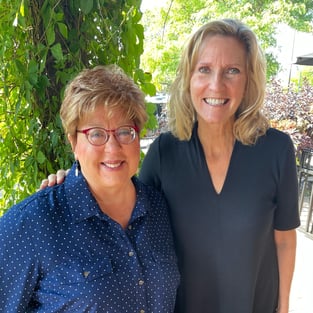
Alums Sue Allers Hatlie and Lynda Lee Promote Healing in Prisons

Alums Chaplaincy

Lynda and Sue square 2X

For years, Rev. Dr. Sue Allers Hatlie (’85, ’04) and Rev. Lynda Lee (’14) felt a strong call to work with individuals in prison. For Sue, who grew up as a Missouri Synod Lutheran, ordination in that faith was not possible for women. Lynda was working in tax compliance for a wealth management firm and “drooling” over ARTS: The Arts in Religion and Theological Studies journal founded by Wilson Yates, United’s Distinguished Professor Emeritus of Religion, Society and the Arts. Fortunately, both ended up at United and found the support they needed to become extraordinary prison chaplains. 

The Road to United

Sue attended college at Concordia College-Moorhead, a Lutheran-founded liberal arts school in northwestern Minnesota. Her plan was to become a lawyer or probation officer, but she relates that upon graduation, college officials sent her directly to Luther Seminary instead. Sue expressed a desire to become a prison chaplain but was told that could only happen after serving as a congregational pastor.

Frustrated, she stepped away from the seminary and took Clinical Pastoral Education (CPE) classes at the University of Minnesota. While there, a Catholic woman asked Sue if she had ever considered the United Church of Christ or United Theological Seminary of the Twin Cities.

Lynda, who graduated from college with a music degree in piano, was always drawn to creative pursuits. She found out about United through their joint project with Minneapolis Institute of Arts and through the ARTS journal, and immediately felt a kinship with the seminary. She had even started volunteering in prisons, playing music, because she felt compelled to be with the prisoners.

When her friend Patsy Herbert,* another artist, said she was taking classes, Lynda was motivated to enroll. Suddenly it seemed that everything in her life was preparing her for this next challenge. Still, it wasn’t until another good friend—Rev. Dr. Verlyn Hemmen, then director of chaplaincy at Allina Hospital—told her to sit down and fill out the application, that she actually set the wheels in motion to attend United.

Experiences at United

For Sue, United and the UCC opened wide the doors of possibility. United created a formation process that would enable Sue to be ordained and work as a prison chaplain. To satisfy her preference for learning by doing, or contextual education, United approved a plan of independent study.

Sue studied liberation theology with Robert Bryant, Professor Emeritus of Constructive Theology. Professor Bryant took his students on an eye-opening trip to Central and South America, including Mexico, Nicaragua, and El Salvador, where the poverty and oppression mirrors the US “school-to-prison pipeline” for people of color.

Fittingly, Sue’s internship was at Minnesota Correctional Facility (MCF)–Shakopee, an all-women’s prison. Once there, she found a mentor: United alum Carrie Dorfman (’78).* Her next CPE took place at the Hennepin County Home School, a behavioral treatment center in Minnetonka for teens in the juvenile justice system.

Since it took her six years to graduate while balancing full-time work and school, Lynda had a lot of time to explore her interest in art. “Cindi Beth Johnson and Jann Cather Weaver were so good!” Lynda remembers. Through their classes, she learned that art was less a product and more an expression and process. Failure wasn’t an option.
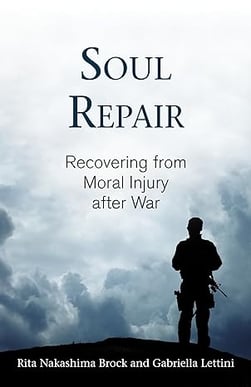
81c1okZeVXL._SY466_During her last semester at United, Lynda attended The Christian Church (Disciples of Christ) Ministers Institute where the keynote speaker was Dr. Rita Nakashima Brock. Brock had just published a book with Gabriella Lettini titled Soul Repair: Recovering from Moral Injury after War. The book, in reviewing the care needed for soldiers who sustain moral injury—an overwhelming sense of shame, grief, and remorse for having violated one’s core beliefs—covers narrative therapy and using art as a piece of that.

During Lynda’s CPE placement at St. Francis Regional Medical Center in Shakopee, she connected with an alternative medicine practitioner who taught her to use aroma therapy and guided imagery for self-care. The premise, as Lynda explains, is that these techniques “release the deep care for another’s story that is not mine to hold.” She learned to hold space for a client’s story, without keeping its emotional weight.

The Good Work

While at the Hennepin County Home School, Sue worked to get a chaplain position funded at the Juvenile Detention Center in downtown Minneapolis. As it worked out, Sue was employed by the Greater Minneapolis Council Churches for more than 30 years serving as a chaplain for Hennepin County Adult and Juvenile Corrections.

During that time, she decided to re-launch a CPE program that the county’s correctional system had ended decades earlier. To do that, Sue dual-tracked a DMin at United with the Certified Educator Training through the Association of Clinical Pastoral Education (ACPE).

At United, she worked with Christie Cozad Neuger (’80), United’s Professor Emerita of Pastoral Counseling and Pastoral Theology, to build her practice of using narrative therapy as a foundation for spiritual care and counseling with those who are marginalized. Once a year, from 1998–2010, Sue also studied in person with narrative therapy founders Michael White and David Epston through training offered by Minneapolis psychologist Dr. Walter Bera.

In 1998, Sue began to offer CPE units in correctional settings. Many chaplains in the Minnesota Department of Corrections have completed CPE with her. In 2017, she started to take CPE students into the MCF–Stillwater for a six-week course in Restorative Justice led by incarcerated men serving life sentences.
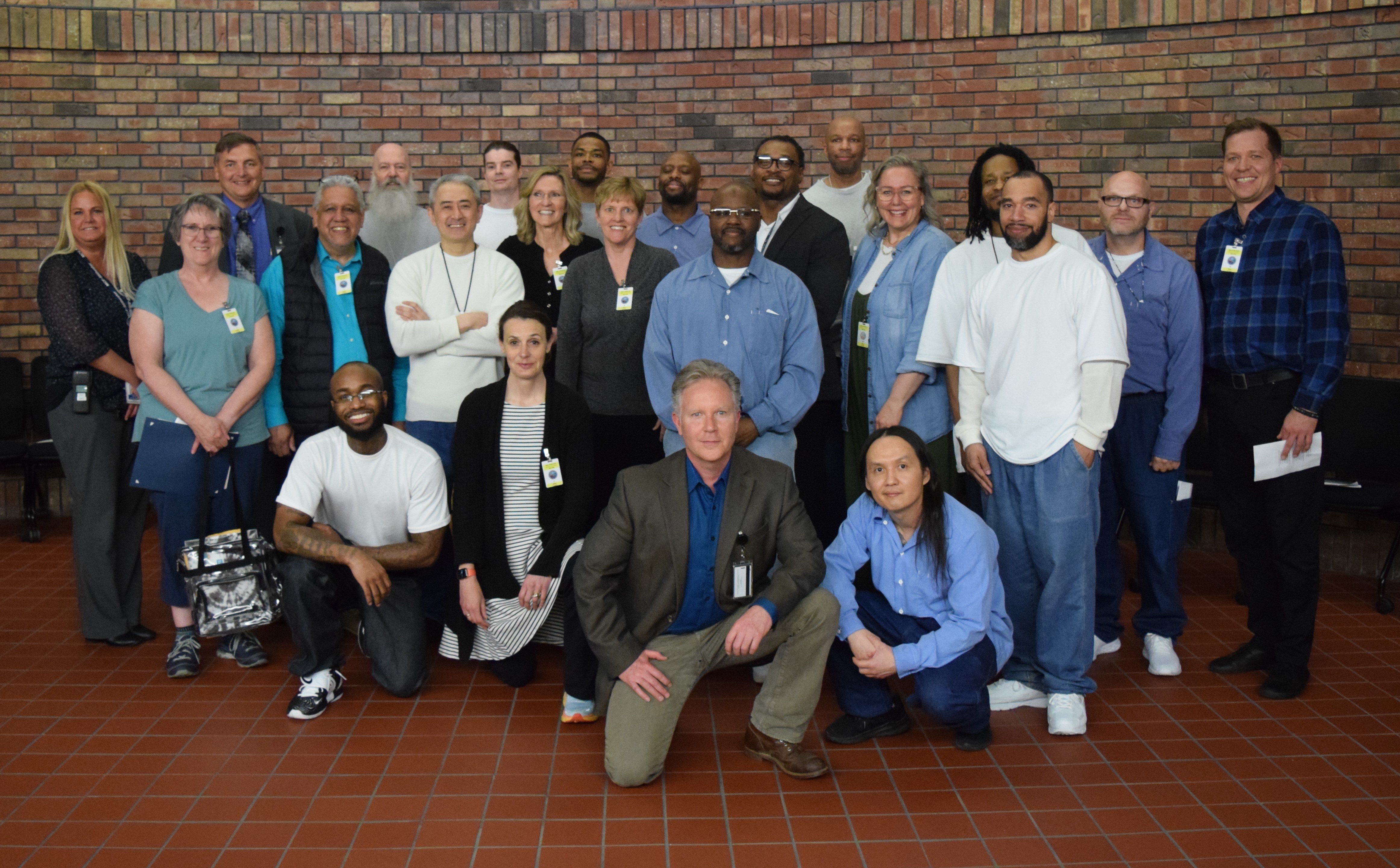
Spring 2023 CPE GraduationCrop

Photo from the Spring 2023 CPE Graduation at MCF–Stillwater.

Two years later, Sue sought funding to allow the incarcerated leaders of the Restorative Justice Council to become CPE students so they could earn master’s level theological education credits and develop their spiritual care skills. Sue’s nonprofit, Social Justice CPE, offers the only units inside prison with incarcerated students in the US. These same students found narrative therapy as a foundation for interfaith spiritual care so life-changing, that many have become adjunct faculty for the Social Justice CPE program.

Lynda retired from her 25-year career in tax compliance in 2014 so she could begin a CPE residency at St. Cloud VA Medical Center the following January. It was there that she developed a specialization in trauma-informed care. Working with veterans in dual diagnosis and PTSD programs, Lynda wrote curricula, curated materials, and facilitated/co-facilitated groups to help individuals deal with inner conflict, self-acceptance, anger management, and image rehearsal therapy (nightmare management).

After completing her clinical residency, job offers came in simultaneously from Allina Health Hospice and the Minnesota Department of Corrections. Once she remembered why she began her seminary journey, Lynda began chaplain work with the Department of Corrections in 2016.

As she explains her choice, “I’m wired to see the underdog and advocate for the underdog, and I understand the oppressor and the oppressed.” She served at MCF-Oak Park Heights and MCF-Stillwater before being called to MCF-Lino Lakes. These days, in addition to providing spiritual care and all religious services, Lynda runs a quarterly grief and loss class for those incarcerated at MCF-Lino Lakes, a unique treatment facility with both medium- and minimum-security housing that also includes opportunities for secondary and higher education.

In working with veterans and incarcerated individuals, Lynda encourages them to identify grief and loss in their life stories. Often trauma occurs in childhood, a time before one has the capacity to make sense of the events in their life. She uses the Internal Family Systems therapy model to identify individuals’ misbeliefs about themselves in a safe and nonjudgmental way so they can embrace those parts with compassion. “Part of the adult waking up,” Lynda explains, “is giving language to the deepest feelings/emotions we have absorbed as children in the midst of trauma.”
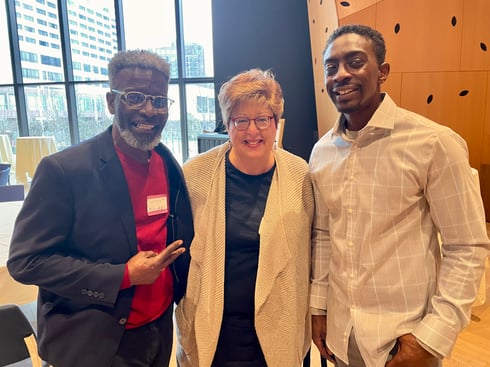
Lifers released and LyndaLeeShe helps them to understand that the action that resulted in their incarceration was likely a desperate means of survival. At the same time, the action does not have to define them, and it doesn’t mean they are defective. By “peeling back layers” of protective veneer to expose foundational sources of grief and loss, Lynda can validate their pain, guide them to process past trauma, and teach them to feel compassion for their younger selves. She also offers spiritual direction in accord with their identified faith.

Restorative Justice

Both Sue and Lynda are committed to Restorative Justice and Liberation Theology. Their beliefs in and practices around trauma-informed care, narrative therapy, and relationship building are a far cry from the prototypically punitive “justice system.” It also offers prison leaders and those who leave prison greater self-awareness and renewed possibilities for hope and purpose.

Wardens at MCF–Stillwater, Sue reports, have recognized that incarcerated individuals who went through the CPE training “make the prisons safer for incarcerated persons and staff.” The 20 trained “spiritual care mentors” (known by other incarcerated men as inmate chaplains) are on call 24–7 and use their well-developed spiritual care skills of de-escalation, conflict mediation, grief and loss processing, and trauma-informed and responsive care.


Damien, David, and John, three CPE alums, discuss the training and its ongoing impact.

As Sue shared in a 2022 Social Justice CPE Newsletter, “As the CPE group forms and stories are told with such courage and accountability, there is a relational quality and sacred space that somehow happens. In the outpouring of stories—some horrendously tragic, some so pain-filled—there is yet the sparkle and shimmer of the spirit…the sacred…the light shining through the clouds.” As one of the incarcerated alums said at a Social Justice CPE graduation, “In this dark place, a little light goes a long way; sparking a hope is contagious.”

Lynda also believes that the space she opens up with narrative therapy and internal family systems work can help each prisoner’s “soul spark” in recognition of their “divine self.” There’s a clear value to walking alongside each person, empowering them to be in charge of their own healing. When she helps prisoners prepare for parole hearings, Lynda explains, “we meet to process their life story, as the focus shifts from their crime and rehabilitation…to their inner story of change. My preferred metaphor is using ‘I am’ statements to ‘keep the boat out of the weeds.’ It is profound work to shift from ‘I’m not going to…and I’m no longer’ to ’I am.’”

Gratitude

To secure relevant spiritual resources for those with whom she works, Lynda says, “United continues to offer a deep bench of consults.” Sue asks, “What would I have done without United honoring my deep desire to do this work?” She has won national awards from ACPE for prophetic and innovative leadership.

United is equally grateful for the spiritual dedication with which Sue and Lynda have ministered to those who have been exiled from society. We applaud their work to recognize that all people, regardless of who they are, what they have done, or what they believe, are beloved members of the community.


* Deceased

Explore More Articles

United Receives Grant from Wabash Center for Teaching and Learning in Theology and Religion

SAINT PAUL, MINNESOTA, UNITED STATES, April 23, 2026. In the wake of Immigration and Customs Enforcement’s (ICE’s) occupation of the Twin Cities metro region since early 2026, United Theological Seminary of the Twin Cities (United) has secured a $30,000 grant to help, as the grant proposal states, “process our experiences of this time, both the blessings and the trauma, so that we can remain effective and compassionate educators and draw on our experiences in a way that expands student knowledge.” The grant, awarded April 2, will fund a two-year project titled “Teaching and Learning in the Midst of Government-Sponsored Violence.” Rev. Dr. Justin Sabia-Tanis, Associate Professor of Christian Ethics and Social Transformation, supported by the McVay Endowment, and Director of United’s Social Transformation program, envisioned, proposed, and will lead the project in collaboration with staff. “We wish to explore,” Rev. Dr. Sabia-Tanis articulated in the grant proposal, “which practices of support are effective for faculty, and other school personnel, that equip us to engage with our students in healthy, meaningful, and productive ways during this time of crisis. Drawing on what we learn, we seek to create a model of care for our seminary that can be of use to other educators who may face unprecedented and protracted times of crisis and violence.” Rev. Dr. Sabia-Tanis identified these goals: Offer effective support to seminary faculty and staff who have been impacted by Operation Metro Surge, both for the well-being of our educators and to consider how best to support students who have been traumatized by the political situation.  Draw upon our experiences as practitioners in justice and peace efforts in the Twin Cities to provide meaningful learning opportunities for our students preparing for ministry and community service.  Collect and preserve primary sources related to street activism and chaplaincy, and the life and teachings of faith communities as a resource for teaching about theology, worship, arts, and social movements. Make these materials accessible to a wide audience of educators, with a focus on theological educators and faith leaders. Citing United’s long history of educators acting as public theologians—60+ years of teachers who were also protesters, activists, justice-practitioners, and thought leaders—Rev. Dr. Sabia-Tanis noted that “this moment offers us the opportunity to live our faith and to transparently share that with our students.” Explaining further, he continued, “The religious imperative to act with compassion and to champion justice, especially for those who are vulnerable, is not simply an academic conversation but an authentic expression of our beliefs and convictions. Loving your enemy and welcoming the stranger are not theoretical questions but ones that demand our concrete and immediate responses daily.” In her grant award letter, Dr. Nancy Lynne Westfield, director of the Wabash Center, asserted, “Your project is poised to make a significant impact.” She added, “Thank you for your commitment to strengthening teaching and the teaching profession.” Rev. Dr. Cindi Beth Johnson, Vice President for Advancement—with whom Rev. Dr. Sabia-Tanis collaborated during the proposal process—remarks, “By virtue of our location and in honor of the stellar work that our alums, students, faculty, and community members have done, and are doing, United is uniquely qualified to lead this important project.” With support from the Wabash Center, United’s Leadership Center for Social Justice is working to gather and preserve information about non-violent resistance and resilience efforts that emerged in response to the ICE Occupation in Minnesota. We invite you to be a part of this project, especially those in Minnesota; please click here to submit resources and materials developed in response to Operation Metro Surge. About United Theological Seminary of the Twin Cities Founded as a welcoming, ecumenical school that embraces all denominations and faith traditions, United Theological Seminary of the Twin Cities has been on the cutting edge of progressive theological thought leadership since it was established in 1962. Today, United continues to educate leaders who dismantle systems of oppression, explore multi-faith spirituality, and push the boundaries of knowledge. About the Wabash Center for Teaching and Learning in Theology and Religion Founded in 1996 through a Lilly Endowment, Inc. “Theological Teaching Initiative” grant, the Wabash Center for Teaching and Learning in Theology and Religion in Crawfordsville, IN, exists to “enhance and strengthen education in theology and religion in theological schools, colleges, and universities.” In so doing, it aims to enhance the “impact of religious leadership on both congregations and public discourse.” Contact Nathanial Green (he/him), Director of Marketing and Communications United Theological Seminary of the Twin Cities press@unitedseminary.edu • 651.255.6138

What Is Eco-theology/Eco-justice?

Introduction For many, many decades now, as humanity’s careless and pernicious actions have caused a global environmental crisis, the world has experienced increasing incidences of devastating droughts and water scarcity, catastrophic floods, widespread and destructive fires, dangerously rising sea levels, melting glaciers, damaging storms, and rapidly declining biodiversity due to habitat loss. Soil erosion and toxified land and water contribute to the swelling swaths of inhospitable landscapes. In an anthropogenic world, we are careening toward certain ruination.  Eco-theology, a constructive, praxis-oriented, and liberation-leaning theology that emphasizes interrelationships between religion and nature, strives to break the cycle of anthropocentric dominance of nature and restore an ethos of preserving and healing the natural world, drawing upon the wisdom of religious traditions from around the world. Eco-justice brings into focus those people and ecosystems who suffer most from human-made natural disasters, industrial pollution, and a lack of clean air and water.   Understanding Eco-Theology If we understand the term “eco-theology” as encompassing not only doctrines formulated by those who use the term “eco-theology” nor only doctrines that belong to theistic traditions, but instead understand “eco-theology” as encompassing all eco-friendly dimensions of religious doctrines around the world, then eco-theology could be said to have countless versions. These range from Christian teachings on stewardship to Islamic teachings on the signs of God in nature to Buddhist teachings on interdependence and on showing compassion to all creatures.  The very first expositor of religious teachings in response to the environmental crisis, in particular, Dr. Seyyed Hossein Nasr, explained that the ecological crisis is rooted in a spiritual and intellectual crisis in which nature is no longer considered sacred, but, through modernism, has been viewed for its material dimension alone.1 Among the salient features of eco-theology is the re-establishment of a view of the sacred in nature, the rediscovery of metaphysics to see the cosmos and the human in light of the sacred, the examination of scriptures and religious teachings for their environmental wisdom, the study of religious and traditional practices for their positive environmental effects, and the development of ethics and discourses that could lead to a harmonious relationship between humanity and nature.   Definitions of Eco-Theology As Ernst Conradie, a South African eco-theology expert, posited in 2004, “The danger of reading into the text randomly may be avoided if the articulation of such ecojustice principles is done in conjunction with historical, literary, and cultural modes of analysis.”2  Eco-theology must be rooted within context. It cannot ignore the destructive arc of human hubris that felled forests, reconfigured rivers, overtook habitat from plants, animals, and native cultures, and cratered and covered the land with impervious surfaces and structures. At the same time, it must heed the quantifiable realities of the ecological crisis, while lifting up Christian scriptures that encourage a more communal relationship with nature, and working with other faith communities to actively push for change.  “I have come to understand eco-theology,” observed Rabbi Lawrence Troster, an environmental activist and eco-theologian, in 2013, “as the integration of the new scientific perspective on the natural world with traditional theological concepts, producing a new theological paradigm.”3 Kelebogile Thomas Resane, a research fellow for the Department of Historical and Constructive Theology at the University of the Free State in South Africa, adds,  Ecotheology is a form of constructive theology that focuses on the interrelationships of religion and nature, with a special focus on environmental concerns. Ecotheology reflects the positive response and sagacious thinking of contemporary religious thinkers to the ecological crisis. It advocates and reconfirms the trinitarian relationship of God-humanity-nature to approve the sacredness of the natural world and to realise the harmonious coexistence between human beings and the cosmos.4   Origins of Eco-Theology Seyyed Hossein Nasr, an Iranian-American scholar and philosopher born in 1933, articulated a tie between spiritual dimensions and the environmental crisis in a series of lectures at the University of Chicago in May 1966, marking the first historical identification of the environmental crisis as being rooted in a spiritual crisis. In 1968, the lectures were published in an innovative and pioneering book titled Man and Nature: The Spiritual Crisis of Modern Man. In Man and Nature, Nasr speaks of a “disequilibrium between modern man and nature” caused by the “destruction of the harmony between man and God.”5 He also points to a disconnect between humanity’s outward and inward life. “For a humanity turned towards outwardness by the very processes of modernization,” he writes, “it is not so easy to see that the blight wrought upon the environment is in reality an externalization of the destitution of the inner state of the soul of that humanity whose actions are responsible for the ecological crisis.”6 Historian and University of California at Los Angeles professor, Dr. Lynn White, Jr., galvanized the Western eco-theology movement with his 1967 essay in the journal Science, “The Historical Roots of Our Ecological Crisis.” In his treatise about the historical underpinnings of humanity’s  subjugation of nature, White states early, “All forms of life modify their contexts.”7 He goes on to trace developments in technology (as early as 800 AD) that started to harness water and wind power through modern times, noting the role that Christianity played in promoting the idea of humans as nature’s master. Both Nasr and White reference St. Francis of Assisi as a model of a humble man who revered nature. White proposes that Francis be a “patron saint for ecologists” since “present science and present technology are so tinctured with orthodox Christian arrogance toward nature that no solution for our ecologic crisis can be expected from them alone.”8 While Nasr considers St. Francis to be a good model for being in harmonious relationship with the environment, he sees that, moreover, religious traditions around the world have countless models, teachings, and even traditional sciences and crafts that we could learn from and see to apply today.   Beliefs that Support Eco-Theology In his 2004 review of the Earth Bible Project,10 Conradie outlines the core principles and beliefs that underpin ecotheology.  Page 128:  Ecotheology believes that our world, and everything within it, has intrinsic worth. Every fungi, plant, animal, protista, and monera springs forth with innate value. Ecotheology understands that the Earth is an interconnected and interdependent community of living things. As Conradie notes, “We are deeply dependent on the complex web of relationships that allows life on Earth to flourish.”11 Ecothology gives voice to the Earth, in celebration and to call out injustice. Ecothology posits that the universe, Earth, and all of its components are part of a cosmic design, and each component plays a role in that system. Ecothology advocates a system of mutual custodianship. Responsible custodians should operate not as rulers but as partners with Earth to sustain essential balance and diversity. Ecothology respects Earth and its inhabitants’ ability to suffer from human-created crises, as well as the power to resist injustice.    The Theology of Eco-theology One salient teaching of religious wisdom bearing on solutions to the environmental crisis is that the rupture of the balance between humanity and nature is rooted in a preceding rupture in the balance between humanity and Heaven. “The Earth is bleeding from wounds inflicted upon it by a humanity no longer in harmony with Heaven and therefore in constant strife with the terrestrial environment.”12 Poets, scientists, and clerics have long agreed that there is something divine within our natural world. George Washington Carver, a prominent agricultural scientist and inventor whose life spanned the 19th and 20th centuries, once wrote, “I love to think of nature as an unlimited broadcasting system through which God speaks to us every hour, if we only tune in.” In his 1854 book, Walden, naturalist, philosopher, and transcendentalist Henry David Thoreau asserted, “The pure Walden water is mingled with the sacred water of the Ganges.” In more recent times, as a largely agrarian society gave way to rampant colonization and industrialization, many people have lost touch with a contemplative, selfless spirituality of nature. These effects are most acutely felt in indigenous communities. In Braiding Sweetgrass, Robin Wall Kimmerer—Distinguished Teaching Professor and Director, Center for Native Peoples and the Environment at State University of New York, Environmental Science and Forestry—writes, “For all of us, becoming indigenous to a place means living as if your children’s future mattered, to take care of the land as if our lives, both material and spiritual, depended on it.”13 By reminding believers that Earth and its environment are sacred, Christian theologians can promote similarly relevant moral and ethical principles. As Willis Jenkins, the John Allen Hollingsworth Professor of Ethics and chair of the Department of Religious Studies at the University of Virginia, explains, “pragmatic theological creativity already characterizes lived Christian experience. As concerned communities confront problems by producing new ethical capacities from their traditions, they rediscover or invent the ecological dimensions of Christian experience.”14   Eco-Theology in Practice Eco-theologian Heather Eaton, professor of Conflict Studies at Saint Paul University in Ottawa, Ontario, suggested in 2004 that there are four clearly defined religious approaches to the present ecological crisis. The first tactic, promoting ecological stewardship among congregants, she notes, includes both “a biblical motif as well as an easily acceptable ecological paradigm for many Christians.”15 Theologically, the largely New Testament invitation is to take care of God’s creation by preserving and conserving natural resources. The second approach, which reveals a greater level of complexity within the ecological crisis, is eco-justice. Consonant with liberation theologies, eco-justice, Eaton asserts, illustrates how “ecological problems are enmeshed with other systemic social problems, such as discrimination based on ethnicity, class, or gender.”16 In this approach, the theological focus is on justice—how to make certain finite resources are distributed equitably to all, particularly to those who are disenfranchised or at society’s margins.  Eco-feminism, an amalgam of ecological and feminist perspectives, draws from the nexus between women, nature, and their common mistreatment across time. As eco-feminist theologian Rosemary Radford Ruether wrote in 1974: “Women must see that there can be no liberation for them and no solution to the ecological crisis within a society whose fundamental model of relationships continues to be one of domination.”17 The role of cosmology, the important fourth approach, Eaton explains, is to illuminate “both the scientific understanding of the universe as well as the macro-narratives through which human communities appreciate their existence.” In her article in the 1990 book, Liberating Life: Approaches to Ecological Theology, theologian Sallie McFague states, “I propose that one theological task is an experimental one with metaphors and models for the relationship between God and the world that will help bring about a theocentric, lifecentered, cosmocentric sensibility in place of our anthropocentric one.”18 McFague’s cosmological reframing of “the world as God’s body” wrests eco-thelology from the yoke of destructive humanity.   Eco-Justice: A Call to Action “Ecology, ” observes Conradie, “touches on virtually every single academic discipline so that the biophysical, geological, political, economic, health, safety, ethical, philosophical, religious, and theological dimensions of ecology all need to be factored in.”19 Eco-justice, precisely because ecology is so complex, strives to reveal and address multivalent consequences of environmental degradation that disproportionately affect impoverished and marginalized human communities as well as the rich profusion of plant and animal species. As German reformed theologian Jürgen Moltmann proclaimed in “The Great Ecological Transformation:”  We need both a “great transformation” and ecological justice that gives the nature of the earth and the animals their rights. We also need to recognize that ecological justice is related to social justice and, especially, to the rights of future generations. We need a new understanding of nature that liberates the nature of the earth from its modern, alienated status as a mere object. We need a new understanding of humanity that embeds human beings in the community of creation. Finally, we need a new cosmic spirituality that sanctifies lived life and engenders “respect for life” for everything that lives.20 Centuries of environmental pillaging has wrought mass destruction of fragile ecosystems. Too often, as in the case of industrial pollution, toxified land and underground water supplies harm communities who have few resources to fight or no voice at all. The erosion of topsoil, essential for food production, can hurt us all, but will mostly harm those who are already food-insecure. In almost all cases, the effects of climate change will displace and destroy those life forms that lack the resources or adaptability to move to safety. Eco-justice concentrates on the attendant ills intrinsic to environmental degradation on a global scale. It fights ethically for what eco-theologians Mary Evelyn Tucker and John Grim describe as “new forms of equitable distribution of wealth and resources” worldwide.21 It asserts the rights of chronically disadvantaged populations and threatened species, and propels society toward a more sustainable model of existence.   Pursuing an Eco-Justice Degree at United Theological Seminary of the Twin Cities United added an Eco-Justice concentration to its MA degree program in early 2022. The MA in Eco-Justice offers students the opportunity to become uniquely prepared faith and spiritual leaders and academics in the areas of environmental ethics, ecological justice, and eco-theology. Equipped through the lens of a religiously-formed and scientifically-informed framework, these students will have the knowledge and skills to address pressing issues facing our planet: climate change, environmental crises, and ecological harm, as well as their embeddedness in spiritual and intellectual matters The Eco-Justice program at United seeks justice for the environment with recourse to the wisdom of religious traditions around the world. Dr. Munjed Murad, who successfully defended his ThD dissertation, “A Tale of Two Trees: Unveiling the Sacred Life of Nature in Islamic and Christian Traditions,” at Harvard Divinity School in 2022, joined United’s faculty the same year. In early 2023, he was installed into the Johnson-Fry Endowed Chair in World Religions and Intercultural Studies. In his courses, Dr. Murad helps students draw upon religious traditions from around the world for wisdom with which they can respond to the Anthropocene. He writes, “To undo [the global environmental crisis], we need a rediscovery of nature through the sacred. It is the sacred alone that can affirm fully and objectively the spiritual value of non-human creatures.”22 United has long supported greater awareness and action on issues related to ethics and eco-theology. For example, we regularly host the Picard Lecture on Environmental Theology and Ethics, supported by an endowment made possible through the generosity of United alum, the Rev. Frank Picard (’02), and other Picard family members.  Launched in 2005, the purpose of the lectureship is to explore questions and issues concerning the state of the creation from theological and ethical perspectives. It seeks to raise questions such as the relation between our spiritual life and the state of the natural world, and the response of religious leadership to the decline of the planet. In establishing the endowment, the Picard family especially wishes to remember the deep appreciation for God’s creation they shared with the late David and Roland Picard. In April 2019, our guest speaker was Dr. Nathaniel Van Yperen, chair of the Religion Department at Princeton Theological Seminary, speaking about his 2019 book, Gratitude for the Wild: Christian Ethics in the Wilderness. Eco-feminist theologian Dr. Catherine Keller, the George T. Cobb Professor of Constructive Theology at the Theological School and Graduate Division of Religion within Drew University, appeared over Zoom in April 2022. Her speech was titled “Apocalypse After All? Climate, Politics and Faith in the Possible.” Held in October 2024, Dr. Kiara Jorgenson, associate professor of Religion and Environmental Studies at St. Olaf College, delivered an address titled “Hope through Tears.” Two respondents, Dr. Timothy Eberhart and Dr. Munjed Murad, presented brief reflections on Dr. Jorgensen's remarks. Even our Susan Draper White Lecture turned to eco-eschatology in 2022, when adjunct professor Rev. Dr. Nancy Victorin-Vangerud spoke. Her lecture—titled “Re-soil/ing the New Jerusalem: Dream-Reading Revelation (22:2) and Women’s Speculative Fiction for a Future that Feeds Us”—started with this startling statement: “Since colonization, erosion of the soils in Minnesota has increased 100-fold.” Because the need to address the world’s environmental crisis in meaningful ways grows more dire every year, United’s MA in Eco-Justice can allow students to pursue careers such as: A scholar or professor in a seminary, divinity school, or college An ethics teacher in a private school, church, or religious community A “public theologian” whose primary audience is society or the wider culture An environmental program leader A leader in a progressive eco-justice think tank A minister who makes eco-justice a central component of their church mission   Conclusion “The Great Work now,” noted renowned cultural historian and religious scholar Thomas Berry in his 1999 book The Great Work: Our Way into the Future, “is to carry out the transition from a period of human devastation of the Earth to a period when humans would be present to the planet in a mutually beneficial manner.”23 Berry, who died at age 94 in 2009, knew what was at stake. The damage to our ecosystem from centuries of exploitation is incalculable, and the consequences are dire. The global climate crisis, caused largely by human activity, will continue to worsen without a worldwide effort to stem activities that exacerbate it. Empowered by religious understanding and a clear ethical compass, faith leaders can work at the vanguard of eco-theology and eco-justice. Their work is imperative since the effects of environmental degradation are too often visited on those least equipped to withstand them, and we all stand to lose as the environment deteriorates.   References/Credit:  Seyyed Hossein Nasr, Man and Nature (Chicago, IL : ABC International Group, 1997). Ernst M. Conradie, “Towards an ecological biblical hermeneutices: a review essay on the Earth Bible Project: review article,” Scriptura 85 (2004): 123–135. https://journals.co.za/doi/abs/10.10520/EJC100654 Lawrence Troster, “What Is Eco-Theology?” CrossCurrents 63, no. 4 (December 2013): 380–385. https://onlinelibrary.wiley.com/toc/19393881/2013/63/4 Kelebogile Thomas Resane, “Moltmann Speaking at the Ecoenvironmentalists’ Conference: Ecology and Theology in Dialogue,” Scriptura 120, no. 1 (2021):1–16. https://scriptura.journals.ac.za/pub/issue/view/173  Nasr, Man and Nature (Chicago, IL : ABC International Group, 1997): 20. Nasr, Man and Nature (Chicago, IL : ABC International Group, 1997): 3.  Lynn White, “The Historical Roots of Our Ecological Crisis,” Science 155, no. 3767 (March 10, 1967): 1203–1207.  White, 1207. Seyyed Hossein Nasr, Religion and the Order of Nature (Oxford: Oxford University Press, 1996). Conradie, “Towards an ecological biblical hermeneutics,” Scriptura 85 (2004): 128  Ibid. 127  Nasr, Religion and the Order of Nature, 3. Robin Wall Kimmerer, Braiding Sweetgrass: Indigenous Wisdom, Scientific Knowledge, and the Teachings of Plants (Minneapolis, MN: Milkweed Editions, 2013): 9. Willis Jenkins, “After Lynn White: Religious Ethnics and Environmental Problems,” Journal of Religious Ethics 37, no. 2 (June 2009): 283–309. https://onlinelibrary.wiley.com/doi/10.1111/j.1467-9795.2009.00387.x Heather Eaton, “This Sacred Earth: At the Nexus of Religion, Ecology and Politics,” Sciences Pastorales, 2004, pages 35-54. [ISSN: 0713-3383] Ibid. Rosemary Radford Ruether, New Woman/New Earth: Sexist Ideologies and Human Liberation (New York: Seabury Press, 1974): 204. Sallie McFague, “Imagining a Theology of Nature: The World as God’s Body,” Liberating Life: Approaches to Ecological Theology, eds. Charles Birch, William Eakin, and Jay B. McDaniels.  (Maryknoll, NY: Orbis Books: 1990), 201–227. Ernst Conradie, “A Green Reformation of Christianity? Anthropological, Ethical, and Pedagogical Reflections on Ecology as an Ecumenical Theme,” Scriptura 120, no. 1 (2021): 1–10. https://scriptura.journals.ac.za/pub/article/view/2006 Jürgen Moltmann, “The Great Ecological Transformation,” trans. Steffen Lösel,Theology Today 80, no. 1 (2023): 9–17. https://journals.sagepub.com/doi/10.1177/00405736231151651 Mary Evelyn Tucker and John A. Grim, “Introduction: The Emerging Alliance of World Religions and Ecology,” Daedalus 130, no. 4, Religion and Ecology: Can the Climate Change? (Fall 2001): 1–22. Munjed M. Murad, “Perceiving Nature: Rūmī on Human Purpose and Cosmic Prayer,” I of the Heart: Texts and Studies in Honor of Seyyed Hossein Nasr, eds. Muhammad U. Faruque, Atif Khalil, and Mohammed Rustom (Leiden: Brill, 2025): 261–275. Thomas Berry, “The Great Work,” The Great Work: Our Way into the Future (New York: Bell Tower, 1999): 3.

Dr. Ginger Morgan Announced as New Associate Professor and Program Director for Interreligious Chaplaincy

Saint Paul, Minnesota, United States, April 16, 2026 — United Theological Seminary of the Twin Cities is thrilled to announce that Dr. Ginger Morgan will join its faculty as the new Associate Professor for Pastoral and Spiritual Care and Program Director for Interreligious Chaplaincy. Dr. Morgan will come to United from Madison, WI, where she is concluding her role at the Presbyterian Student Center Foundation as director of Candid and Community Initiatives. She is a highly qualified program director and chaplain with experience in healthcare, campus ministry, and higher education. With a PhD in Religion and Psychological Studies from Iliff School of Theology at the University of Denver, as well as a Master of Theological Studies (MTS) from Vanderbilt Divinity School, Dr. Morgan draws from her theological and multidisciplinary education in her work. Interreligious studies is one of United’s four pillars, and the Interreligious Chaplaincy (IRC) program—unique among peer institutions—constitutes the largest and fastest-growing of the seminary’s programs over the past five years. In alignment with United’s ethos, Dr. Morgan is a gifted scholar of religious pluralism, highly educated in progressive theological education, and foregrounds justice in chaplaincy and pastoral care. These values are evident in a chapter titled “Many Doors: Expanding Thresholds for Grace,” written by Dr. Morgan for the upcoming book Dispatches from Campus (Augsburg Fortress Press). Dr. Morgan’s career also reflects her personal experiences and identity. Writing to the search committee, she shared, “My formation includes reconciling my lesbian identity with my faith and living as a religious minority in India during high school, both of which shaped my intercultural perspective and vocational commitments.” She continued, “Throughout my career, I have sought to create inclusive spaces of belonging, whether supporting LGBTQIA+ students, young adults in recovery from addiction, or building programs attentive to justice and equity." Rev. Dr. Molly T. Marshall, President, reflects, “United welcomes Dr. Ginger Morgan with confidence and great enthusiasm. Her varied leadership roles, especially in chaplaincy, equip her uniquely to lead our robust IRC program and to teach pastoral and spiritual care.” In his announcement to the student body, Dr. Kyle Roberts—Dean and Vice President for Academic Affairs—noted that Dr. Morgan’s “career in chaplaincy spans hospital, hospice, and higher education contexts, and extensive program leadership experience.” He added, “I want to thank Dr. Demian Wheeler for leading this search process, especially during its formative stages during my sabbatical.” After participating in a months-long faculty search and on-site candidate lecture, being recommended by a unanimous faculty vote, and gaining approval from the Board of Trustees’ Academic Committee, Dr. Morgan will officially begin on July 1. Students, faculty, and staff are eager to welcome her to United for this exciting new chapter. For more information about United’s Interreligious Chaplaincy program, click here. About United Founded by the United Church of Christ (UCC) as a welcoming, ecumenical school that embraces all denominations and faith traditions, United Theological Seminary of the Twin Cities has been on the creative edge of progressive theological thought and leadership since it was established in 1962. Today, United continues to educate leaders who, through the eyes of faith, engage in the dismantling of systems of oppression, exploring multi-faith spirituality, and pushing the boundaries of knowledge. Contact Nathanial Green (he/him) Director of Marketing and Communications press@unitedseminary.edu • (651) 255-6138 Admissions and Enrollment admissions@unitedseminary.edu